From recognising a problem to explaining the right action.
Explore workplace conditions, welfare, electricity and structural integrity through real decisions. Every unfamiliar term is explained, every lesson includes practice, and every tool asks you to examine the evidence behind your answer.
Fictional Northstar examples and generated scenes support discussion. They are not records of a real organisation. UK examples identify Great Britain unless stated otherwise; check your local legal requirements.
Begin with the purpose
Why this unit matters
A safe working environment depends on suitable conditions and continued verification. What must a workplace provide, and what evidence is needed to establish that people remain protected as tasks, equipment and circumstances change? Unit 5 examines the conditions in which work takes place. It connects the workplace as a whole with the individual factors that can support or undermine health and safety.
Here, working environment means the physical surroundings and conditions in which people perform their tasks: the building, layout, air, temperature, light, routes, welfare facilities, equipment and substances. These conditions must be examined together with the people using them and the way work is organised. In this unit, environment does not mean only pollution or the natural environment. A workplace can look tidy while its lighting is unsuitable for a detailed task, its washing facilities are unavailable on a night shift, or a change in loading has not been assessed. HSE similarly considers healthy conditions, welfare facilities and the safety of premises together. W5
What maintaining a safe working environment means
Maintaining means keeping conditions suitable over time, not simply making an improvement once. Ask what the task requires, examine the present conditions, identify who could be harmed and how, evaluate the controls, act on shortcomings, and check again when something changes. An inspection is a structured examination of conditions; an assessment is the reasoned interpretation of what those conditions mean. Neither a completed checklist nor a quiet accident record answers every question about current protection.
Health and safety belong in the same discussion. Some events cause an immediate injury, while other exposures may cause harm after repeated or prolonged contact. The same workplace feature can affect both. The assessment question is therefore wider than whether an accident could occur. It includes how the conditions affect people doing the work and what evidence would show that their protection is suitable.
What you should be able to do by the end
By completing the learning and developing your own assignment evidence, you should be able to explain the unit's technical ideas, apply them to a workplace and justify a professional judgement. The following capabilities describe the teaching purpose; the official LO and AC remain the assessment requirements. Successful assessment depends on demonstrating those requirements, not on attendance or reading alone. O1
Learning area
Knowledge you build
What you should be able to demonstrate
Section 1: working environment
How conditions, welfare, electricity and building integrity affect people
Examine an actual workplace, explain the hazard mechanisms and evaluate whether arrangements suit the work and workforce
Section 2: workplace contexts
Why tasks, locations, noise, vibration and radiation need different controls
Compare controls with the particular activity and exposure, and explain the evidence and specialist input needed
Section 3: fire and explosion
How ignition, spread, protection and escape interact
Explain a connected prevention and emergency strategy, including its limitations
Section 4: hazardous substances
How harmful agents are identified, reach people and are controlled
Follow the path from source to exposure, justify controls and examine their performance
Section 5: equipment and machinery
How selection, safeguards, maintenance and use affect safety throughout equipment life
Evaluate equipment for its real tasks, including abnormal work, and recognise when competent technical assessment is needed
Connect study, professional practice and assessment
The examples and activities develop a disciplined approach to observation, questioning and professional judgement. In an assignment, demonstrate that reasoning through relevant evidence, an appropriate source, a clear explanation and a justified conclusion. For example, “the workbench has lighting” is a description. Explaining whether that lighting allows the actual task to be performed, what observations support your view and what remains uncertain develops the analysis. Follow each criterion's command word and your current centre-issued brief; these examples are learning guidance, not additional assessment rules.
The professional benefit is a more disciplined way to recognise a problem, explain its significance, select a proportionate response and check whether that response works. Knowing when you need a competent electrician, structural engineer, occupational hygienist or other specialist is part of that judgement. The unit develops your ability to evaluate and coordinate safety arrangements; it does not replace specialist competence.
Why the learning begins with temperature and lighting
The unit begins with the ordinary conditions surrounding a task because they are easy to take for granted. A worker needs to see, move, reach, use facilities and work in suitable conditions before more specialised controls can be evaluated properly. Temperature is an accessible first example of the relationship between the task, the surroundings and the person. Its place at the start is a teaching sequence, not a claim that it is always the most urgent risk. Actual priorities depend on the hazards and exposures found in the workplace.
The sequence then broadens: everyday conditions and welfare; electrical and structural integrity; task-specific hazards and physical agents; fire and explosion; hazardous substances; and equipment. The sections overlap in practice. A workplace change can affect several of them at once. Keep returning to one question: what has changed for the person doing the work, and what evidence will show that the protection still works?
Begin with a familiar place
Choose one workplace or work area you know. Describe the task and the people involved before listing hazards. Ask: what must people be able to see, reach, move through and use? What supplies energy to the work? What supports the loads? What could change across shifts or during maintenance? Keep these questions beside you as you study. This establishes a practical reason to investigate temperature, lighting, welfare, electricity and structure as connected features of work.
Section 1 examines the place in which work happens. A task relies on more than a written procedure: people need suitable conditions, usable facilities, dependable electrical arrangements and a building that remains appropriate for its use. Section 1 teaches you to look at those foundations systematically. Start by understanding the activity and the people involved, then examine how the surroundings help or hinder safe and healthy work. The section progresses from workplace conditions and welfare to electrical and structural hazards and controls. The order helps you build an assessment; it does not set the priority of risks at your workplace.
What this section prepares you to do
By the end of this section, you should be able to outline important environmental factors, justify welfare provision, explain electrical and structural hazards, and use evidence to evaluate the associated controls. You should also recognise the limits of a visual inspection and identify where specialist assessment is needed.
Begin with AC 1.1: what conditions must the workplace provide for the actual task and the people performing it?
A safe workplace depends on how work is actually carried out as well as the condition of its buildings. This section helps you understand why a control that works for one activity may fail in another. You will explore changing tasks, people working without immediate help, physical demands and exposures that may cause harm without an obvious incident.
Outcome and assessment criteria available below. Teaching lessons unlock in a later release.
🔒 Not yet releasedWhat this section prepares you to do
By the end, you should be able to compare controls across distinct work contexts, explain the effects of noise, vibration and radiation, and identify the evidence needed to judge exposure. You will practise asking whether a control prevents harm in the actual conditions and how its effectiveness can be checked.
Building on the idea of a suitable working environment, begin with the task itself: what changes when people move, enter, lift or work alone?
Section 03 · Locked
Fire and explosion
Fire and explosion can connect several familiar workplace weaknesses into a rapidly developing event. A material, an ignition source, a damaged barrier and an obstructed route may each need attention for different reasons. This section helps you understand those connections so that prevention, building protection, warning and escape are considered together rather than as separate checklist items.
Outcome and assessment criteria available below. Teaching lessons unlock in a later release.
🔒 Not yet releasedWhat this section prepares you to do
By the end, you should be able to explain how common materials ignite, trace how fire and smoke may affect a building, and review the contribution of prevention and emergency arrangements. You will also be able to explain the limits of workplace firefighting and identify decisions that need competent specialist input.
The earlier focus on exposure and control reliability now becomes a question about escalation: what prevents an event, and what protects people if it occurs?
Section 04 · Locked
Hazardous substances
A substance may threaten health during an ordinary task even when there is no fire, spill or visible cloud. This section helps you move from recognising a hazardous material to understanding how people encounter it. It addresses a common weakness in workplace assessments: collecting labels and safety data sheets without examining the process, exposure routes or people who need protection.
Outcome and assessment criteria available below. Teaching lessons unlock in a later release.
🔒 Not yet releasedWhat this section prepares you to do
By the end, you should be able to connect substance information with actual work, review storage and transfer arrangements, and explain a reasoned hierarchy of exposure controls. You will consider biological agents, asbestos, lead, personal protection and the effect of hazardous environments on electrical equipment, while recognising where specialist assessment is needed.
Having considered how substances can fuel fire and explosion, now examine their journey through work and the ways they can reach and affect people.
Section 05 · Locked
Equipment and machinery
Equipment can make a task easier while introducing hazards during operation, cleaning, adjustment or repair. This section helps you judge the complete working arrangement, including the machine, its safeguards, its users and its surroundings. The problem to solve is broader than finding a guard or a training record: it is understanding whether people remain protected throughout the equipment's working life.
Outcome and assessment criteria available below. Teaching lessons unlock in a later release.
🔒 Not yet releasedWhat this section prepares you to do
By the end, you should be able to explain equipment selection criteria, distinguish protective functions, and review risk controls across operating states. You will also examine mobile equipment and lifting operations, identifying the planning, competence and verification needed to support a defensible safety judgement.
The earlier sections considered working conditions, exposure and emergencies. Bring those ideas together now by following a piece of equipment from selection through use and change.
The complete unit map
Learning outcomes, assessment criteria and indicative content
The LO and AC wording below is checked against the December 2023 specification and the supplied assignment document. The IC column is an explained topic map; use the linked official pages for OTHM’s complete original wording.
IC is shared across this learning outcome; this teaching map is not an official one-to-one allocation. AC 2.1 bullet formatting is normalised for readability.
Section 2 · Learning Outcome 2 · Lessons locked
Learning Outcome (LO)
Assessment Criteria (AC)
Indicative Content (IC) teaching map
2. Understand the hazards, risks and controls applicable to a range of workplace contexts.
2.1 Evaluate the control measures in place within your organisation to control the following risks: temporary works; workplace transport; working in confined spaces; working at height; lone working; manual handling.
2.2 Outline the types of noise and vibration, the effects of being exposed to these, and their control measures.
2.3 Explain the measurement, assessment and methods to control exposure to noise and vibration.
2.4 Describe effects of being exposed to the different types of radiation.
2.5 Explain the measurement, assessment and methods to control exposure to different types of radiation.
Assessment of confined-space entry, height work and rescue, lone work and emergency communication
Transport: site, routes, activities, vehicles, drivers and shared premises
Handling, posture and repetitive tasks: MAC, ART, V-MAC, DSE, NIOSH MMH and RULA
Noise and vibration effects, exposure assessment, limits and health surveillance
Noise control at source, along the path and at the receiver; absorption, insulation, damping, isolation, diffusion, enclosure and active cancellation
Hearing protection: frequency analysis, SNR/HML and over-protection; automation, maintenance, work organisation and PPE limitations
Radiation effects, measurement and control are required by AC 2.4–2.5 even though the printed IC gives them little separate detail
IC is shared across this learning outcome; this teaching map is not an official one-to-one allocation. AC 2.1 bullet formatting is normalised for readability.
Section 3 · Learning Outcome 3 · Lessons locked
Learning Outcome (LO)
Assessment Criteria (AC)
Indicative Content (IC) teaching map
3. Understand the maintenance of fire safety and protection against explosion.
3.1 Outline the ways that common flammable and explosive materials can catch fire.
3.2 Describe the behaviour of buildings and building contents in the event of a fire.
3.3 Explain the hazards, risks, and control measures in an organisation (including detection systems, alarm systems and evacuation procedures currently in use) for prevention and protection against fire and explosion.
3.4 Outline the factors that must be considered to ensure safe and effective fire-fighting and egress in the event of different types of fire.
Fuel properties, flash/fire points, auto-ignition, vapour density and flammability limits
Ignition sources, fire growth/spread, vapour-cloud explosions and BLEVE
Droplets, dust particle size, oxygen enrichment and oxidisers
Atmosphere control, purging, inerting, hazardous zones, plant design and process control
Separation, quantities, containment, ignition prevention, explosion protection and monitoring
IC is shared across this learning outcome; this teaching map is not an official one-to-one allocation. AC 2.1 bullet formatting is normalised for readability.
Section 4 · Learning Outcome 4 · Lessons locked
Learning Outcome (LO)
Assessment Criteria (AC)
Indicative Content (IC) teaching map
4. Understand safe storage, handling and management of hazardous substances, including biological agents.
4.1 Outline how hazardous substances are classified and the effects of their exposure to human health.
4.2 Explain the key standards for safe storage, handling and transport of hazardous substances in an organisation.
4.3 Outline the features of effective risk assessment and measures of control for exposure to hazardous substances in line with the hierarchy of control.
4.4 Describe the control measures for working with asbestos and lead.
4.5 Explain the factors to consider when choosing appropriate Personal Protective Equipment (PPE) and requirements for PPE in an organisation.
4.6 Explain the impact of hazardous work environments on the installation and use of electrical systems and equipment.
Body systems and routes of entry; innate/adaptive defence; physical form and dust fractions
Classification, labels, hazard/precautionary statements, GHS/CLP and REACH
Carbon monoxide, isocyanates, metalworking fluids, used oil, silica, wood dust, asbestos and lead
International chemical information; bulk/drum storage, compatibility, containment, transfer, dispensing, spraying, disposal and transport
Elimination, substitution, alternative processes, enclosure, LEV, work methods, hygiene and emergency arrangements
Carcinogen/mutagen controls; asbestos/lead methods and specialist arrangements
RPE and breathing apparatus, filters/APF, oxygen, task/wearer factors, compatibility, fit, standards, eye/skin protection, storage, maintenance and training
Electrical suitability in hazardous environments; protective systems, inspection/testing, competence, dead/live work and permits
IC is shared across this learning outcome; this teaching map is not an official one-to-one allocation. AC 2.1 bullet formatting is normalised for readability.
Section 5 · Learning Outcome 5 · Lessons locked
Learning Outcome (LO)
Assessment Criteria (AC)
Indicative Content (IC) teaching map
5. Understand safe management of work equipment and machinery.
5.1 Explain the selection criteria for work equipment for specific tasks and processes in order to manage risk.
5.2 Explain the key safety characteristics, including protective devices, of general workplace machinery control systems.
5.3 Explain the features of effective risk assessment and control measures for work equipment and machinery, including the skills, training and supervision to install, test, maintain and operate equipment.
5.4 Outline the main hazards and control measures associated with mobile work equipment.
5.5 Outline the main hazards and control measures associated with lifting equipment.
Task/process/environment suitability and the safe supply/removal of energy and materials
Ergonomics, anthropometry, controls, access prevention, barriers and separation
Machinery risk-reduction standards and lifecycle safety integration
IC is shared across this learning outcome; this teaching map is not an official one-to-one allocation. AC 2.1 bullet formatting is normalised for readability.
From the author
“Professional judgement begins with a clear question and reliable evidence.”
Build on your health and safety knowledge and professional experience by examining what could harm people, which arrangements protect them and what evidence demonstrates that those arrangements work. Key terms, practical examples and activities support precise, defensible judgement.
Debjyoti Biswas, FIIRSM, CertIOSH
DB HSE International
Section 01 · AC 1.1 · Outline
Conditions that allow people to work safely
Official assessment criterion Outline the critical factors when maintaining the working environment, ie temperature, light, space, ergonomics, lifts, access.
In this lesson
What this criterion asks
Why we study this: Start by understanding the decision behind the command word. This turns the official wording into a practical question you can investigate before deciding what evidence to collect.
Outline means give a clear, organised account of the main features. It does not mean list six words without explaining them. Address temperature, light, space, ergonomics, lifts and access, then show how they interact with the task and the people doing it. An effective outline links each factor to a foreseeable consequence and a practical way of maintaining suitable conditions.
The working environment is more than a room. It includes air, surfaces, routes, fixtures, the arrangement of equipment and the changing conditions of work. A workplace can meet its original design assumptions and become unsuitable when staffing, storage, machinery or working hours change. Maintaining it is a continuing process of checking, correcting and learning. In Great Britain, the Workplace (Health, Safety and Welfare) Regulations cover many ordinary workplaces, with exclusions and additional sector-specific provisions. HSE L24 distinguishes the regulations, the Approved Code of Practice and guidance. W1
Temperature and ventilation should suit the work and the people doing it.Observe: What evidence would help establish whether conditions are comfortable?AI-generated fictional learning prompt. The image does not prove organisational performance or compliance.
Temperature and thermal comfort
Why we study this: Why begin with temperature? People experience the conditions around them while performing a task. This topic illustrates how the surroundings, workload and clothing interact, and why one thermometer reading cannot describe the whole experience. W6
Thermal comfort is a person’s experience of the thermal environment. Air temperature matters, but so do radiant heat, humidity, air movement, clothing and work rate. A wall thermometer alone cannot describe the burden on a worker wearing protective clothing beside a hot process. Cold can affect dexterity and concentration; excessive heat can create discomfort and, in more severe conditions, heat-related illness. Assess the work and the people rather than interpreting one number as a universal safe boundary. W2
HSE guidance normally describes at least 16°C for indoor workrooms, or 13°C for work involving rigorous physical effort. These are guidance values, not universal maximum or minimum legal limits for every situation. There is no single maximum workplace temperature applicable to all tasks. The legal requirement is a reasonable indoor temperature, with risk assessment and appropriate controls. Special activities may require different arrangements. W2
Begin by locating heat and cold sources and identifying tasks, duration and clothing. Consult workers on different shifts. Measure representative conditions, including the worst credible operating periods, and record where, when and how measurements were taken. Consider isolating heat sources, improving ventilation, providing suitable local heating or cooling and modifying the process. Work-rest arrangements, access to drinking water and acclimatisation may support control, but should not conceal an avoidable source problem.
Ventilation means replacing stale indoor air with appropriate fresh air. It can improve general air quality, but general ventilation is not automatically sufficient to control a hazardous emission at source. A fan that moves contaminated air across another worker can make the situation worse. Local exhaust ventilation captures contaminants near where they arise; Section 4 develops that distinction. Check that changes to airflow do not compromise fire arrangements or introduce an additional exposure. W3, C2
Good lighting supports accurate work and helps workers see hazards.Observe: Where could shadows or glare affect this task?AI-generated fictional learning prompt. The image does not prove organisational performance or compliance.
Lighting: enough light, in the right place
Why we study this: Lighting assessment begins by establishing what people need to see to perform the task safely. The purpose is to connect lighting with the work surface, objects, routes and potential hazards, before considering readings or improvements. W4
Illuminance is the amount of light reaching a surface, usually expressed in lux. The relevant surface is the task plane: for example, the label being read rather than an arbitrary point in the room. Consider the visual detail, contrast, glare, shadows, colour recognition and transitions between bright and darker areas. A lux reading does not tell you whether a reflective label is legible or whether a machine’s rotating parts create a misleading visual effect. W4
Start with the task. Observe it during normal production and maintenance. Ask whether users can see small print, moving equipment, changes in floor level and emergency information. Compare findings with appropriate guidance and design specifications. Maintain fittings and clean diffusers; replace failed lamps promptly. Where failure of normal lighting would expose people to danger, suitable emergency lighting is part of the overall arrangements. A portable lamp is not a substitute for an assessed system.
At Northstar, fictional observations show that the bench is brightly illuminated but workers tilt labels to avoid reflected glare. Adding more light without changing the angle could worsen the problem. A trial of diffuse task lighting and altered bench orientation is a better first investigation. The judgement should consider task accuracy, worker feedback and repeated observations after the change, not just whether the room appears brighter.
Routes and workspaces need enough room for safe movement and access.Observe: What might compromise access along this route?AI-generated fictional learning prompt. The image does not prove organisational performance or compliance.
Space, movement and accessibility
Why we study this: Seeing the task is only part of the picture; people must also have usable room to perform it and move around. This topic helps you distinguish the size of a room from the suitability of its actual layout. W1
Space must allow the work, movement, maintenance and emergency escape to happen safely. Gross floor area is not the same as usable working space. Stock, furniture, doors, moving equipment and temporary tasks occupy it. HSE L24 provides guidance on room dimensions, including a normal minimum volume of 11 cubic metres per person calculated with a maximum counted height of 3 metres, subject to its scope and qualifications. That figure is not a complete occupancy or fire-capacity assessment. W1
For teaching, consider a fictional room measuring 5 m by 4 m by 3 m: its volume is 60 m³. Dividing by 11 gives approximately 5.45. This arithmetic does not approve five people working there. Furniture, circulation, the task, ventilation, access needs and escape requirements must still be assessed. A capacity calculator should reveal this limitation instead of presenting a “compliant” badge.
Accessibility means people can use the workplace and its facilities, including people with disabilities. Consult the person about their needs without assuming incapacity. Consider door widths, opening forces, floor levels, rest opportunities, signs and emergency arrangements. A clear route during an inspection may become obstructed during deliveries. Observe the busiest periods and assign ownership for keeping routes usable.
Adjusting work height and reach can reduce strain during repetitive tasks.Observe: Which adjustments could make this task more comfortable?AI-generated fictional learning prompt. The image does not prove organisational performance or compliance.
Ergonomics and lifts
Why we study this: Now consider how people interact with the workplace. Ergonomics asks how work fits the person; lifts raise separate questions about moving people or loads safely. Both require attention to the real use of the arrangement, rather than its mere presence. E1
Ergonomics is fitting work to people, including their physical and cognitive capabilities. Anthropometry concerns human body dimensions. Neither concept is limited to an office chair. Reaching, gripping, repetition, load handling, visibility, controls, pace and decision demands all matter. Adjustability often helps accommodate different users, but adjustments must be understandable and the work must permit people to use them. E1
A practical review observes the complete work cycle, asks workers where discomfort or difficulty occurs, and assesses force, posture, repetition and duration. Trial improvements with users. Raising a bench may reduce bending for one worker and create shoulder elevation for another. Job rotation only reduces exposure when the alternative task changes the relevant demand; rotating between two similarly demanding jobs may not help.
Passenger and goods lifts support access and material movement but introduce crushing, trapping, falls, entrapment and maintenance risks. Check suitability, load limits, door protection, examination and maintenance arrangements, fault reporting and emergency communication. Do not improvise recovery of trapped people. Lifting people carries additional considerations. The applicable LOLER arrangements and competent-person examination scheme must be understood; routine maintenance and thorough examination serve different purposes. M2
Lift suitability, maintenance and inspection information require routine attention.Observe: What would you verify before allowing this lift to remain in service?AI-generated fictional learning prompt. The image does not prove organisational performance or compliance.
Access, housekeeping and slips
Why we study this: A workstation cannot be assessed in isolation from the journey to and from it. Here you learn to examine routes and changing floor conditions as part of the work, including busy periods, cleaning and access for different users.
Access means getting to a place; egress means leaving it. Review ordinary travel, maintenance access and emergency escape. Safety signs communicate a remaining risk or required behaviour. They cannot make a wet floor dry, hold up a structure or physically separate a pedestrian from a vehicle.
The coefficient of friction, or CoF, describes the relationship between frictional force and normal force under specified conditions. For a floor, its meaning depends on test method, contamination, footwear and movement. Do not use an unexplained CoF number as proof that all users will be safe. Assess how contamination reaches the floor, how quickly it is removed, whether the surface is suitable and how footwear performs in actual conditions. S1
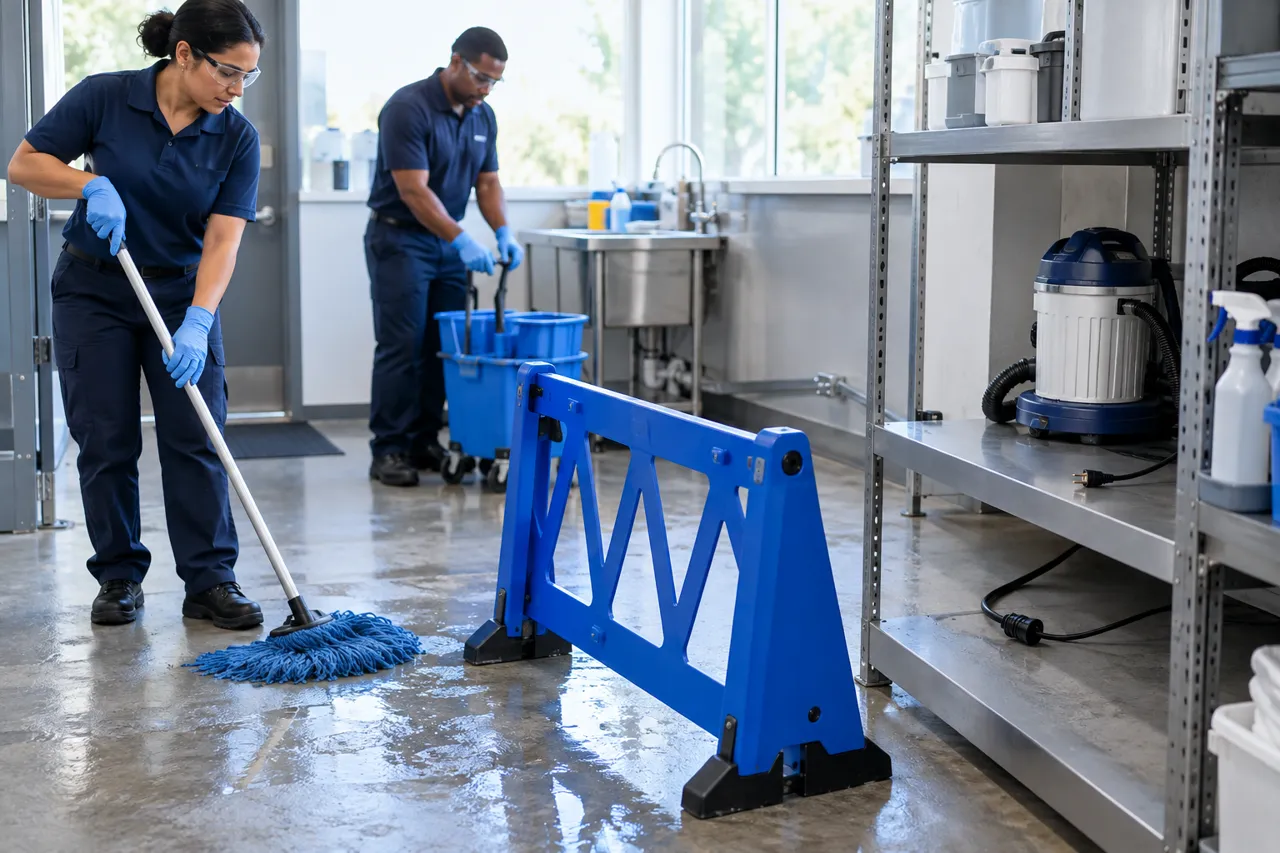
Effective housekeeping is an organised system: appropriate storage, clear responsibilities, spill response, waste removal and checks during operating hours. Cleaning can temporarily increase slip risk. Segregate the affected area, provide an alternative route and verify that the surface is ready for use. A cone beside an unavoidable wet route warns but may not adequately protect.
Cleaning arrangements should control access to wet floors and preserve safe routes.Observe: How does this arrangement reduce the chance of a slip?AI-generated fictional learning prompt. The image does not prove organisational performance or compliance.
Workplace application and judgement
Why we study this: We bring the environmental factors together because several conditions may affect the same task. The purpose is to turn separate observations into a reasoned account of what matters and what you still need to establish.
Northstar should first make the wet entrance safe, then investigate water tracking, matting, drainage and cleaning. At the labelling bench, assess glare and posture together. At the goods lift, compare maintenance records with examination findings and check that defects have been resolved. A single “environment satisfactory” tick would hide different mechanisms of harm and different evidence needs.
Use a maintenance cycle: define the standard; inspect under representative conditions; record deficiencies; assign action; verify the repair; and review after change. Include night work, cleaning, contractor work and abnormal operations. The justified conclusion is that a suitable environment is demonstrated by performance under real conditions, not by a tidy appearance during a scheduled visit.
Try it before reading the discussion
Why we study this: Use this pause to test whether you can question an apparently reassuring result. Explain your reasoning before comparing it with the discussion; choosing a conclusion without its reasons misses the learning purpose.
Activity: a manager says, “The lighting reading meets our target, so the bench is safe.” Write two reasons that this conclusion is incomplete. Then propose one observation and one worker question. Discussion: a reading may miss glare, shadows, colour discrimination or the task plane. Observe a complete labelling cycle and ask when labels become difficult to read. Compare the evidence before deciding whether the control works.
Writing framework: identify the factor; explain its relationship to the task; describe the present arrangement; identify a limitation; state the maintenance or review action. Avoid claiming that an illustrative calculation proves legal compliance. Apply tomorrow: walk one route from entrance to workstation and then to welfare and escape facilities, recording where the conditions change.
Pause · apply · explain
Make the learning yours
Write your own evidence-based conclusion
Your text stays in this page unless you choose to save it on this device.
Self-recorded study progress, not an assessed pass.
Official assessment criterion Justify the full range of welfare facilities that must be available in a workplace.
In this lesson
Welfare is part of work design
Why we study this: Begin with the people and the work, not a shopping list of facilities. This helps you explain why a provision is needed and how it must operate to be useful.
Justify means give defensible reasons for a choice. A list of toilets, water and a rest room is a beginning, not a justification. Explain who needs each facility, how the work creates that need, why the quantity and location are suitable, and how provision remains usable throughout the shift. Link your judgement to applicable requirements, worker consultation and operational evidence.
Welfare facilities support health, dignity and recovery. Facilities that exist on a drawing but are locked, contaminated or inaccessible are not effective provision. A toilet at the far end of a site may discourage use when workers cannot leave a process. A meal area beside chemical handling may expose workers to contamination. Evaluate the practical arrangement rather than counting rooms. W1, W5
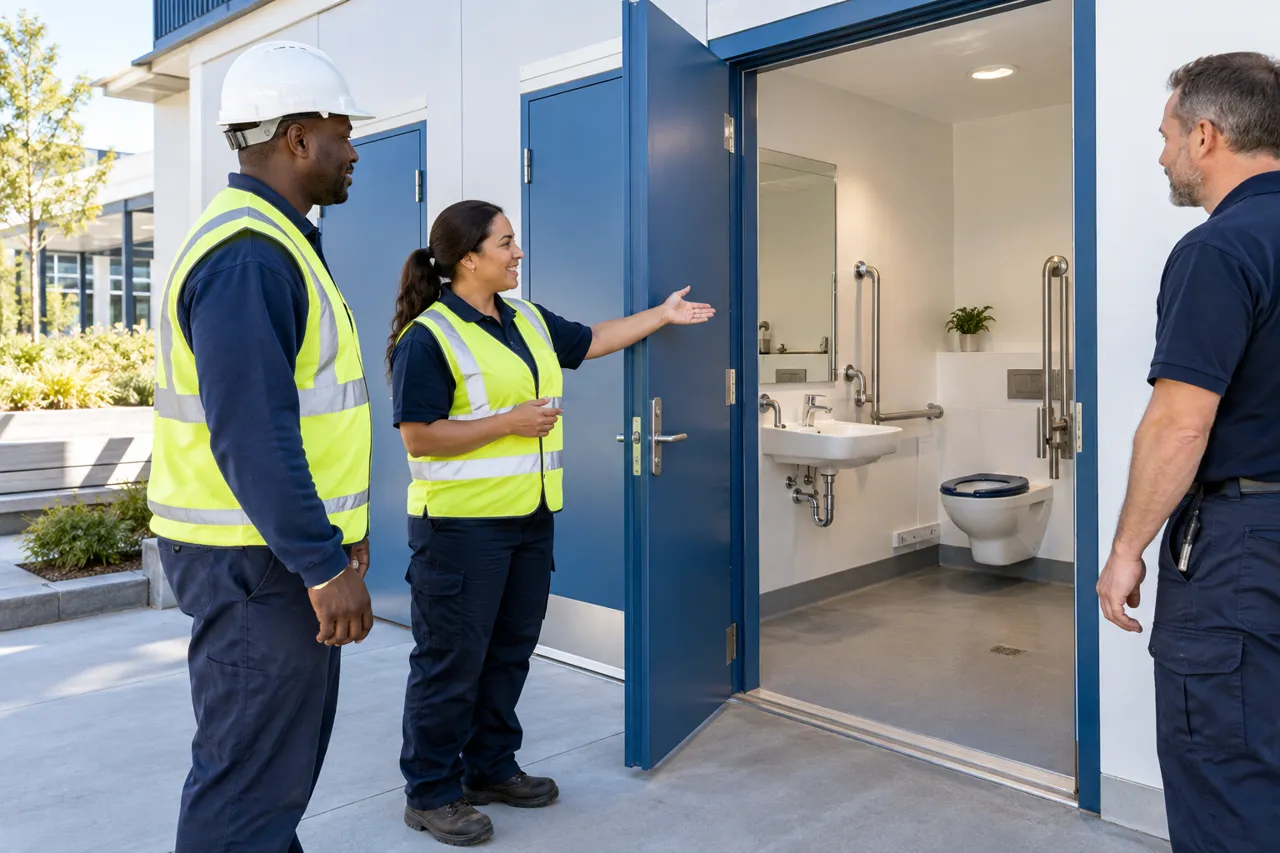
Welfare facilities should be accessible, suitable and maintained in a clean condition.Observe: What else would you check to assess suitability for all workers?AI-generated fictional learning prompt. The image does not prove organisational performance or compliance.
Sanitary conveniences and washing
Why we study this: These facilities meet basic needs during work. We study their suitability and accessibility so your assessment considers actual use, including different workers, tasks and shifts. W5
Sanitary conveniences are toilets and associated arrangements. Consider numbers, privacy, cleanliness, ventilation, lighting, accessibility and separation arrangements required for the workforce. Use the relevant regulatory guidance tables for actual worker numbers and workplace type. Do not substitute an invented universal ratio. Shift overlap, visitors, contractors and temporary workers can affect demand.
Washing facilities need suitable water, cleaning materials and a way to dry hands. Their adequacy depends on the work. Routine handwashing after ordinary work differs from washing after contact with hazardous contamination. Some work requires showers or specialised decontamination arrangements. An emergency eyewash or shower serves an emergency purpose and does not replace normal welfare facilities. Selection and location should follow the substance and process risk assessment. W5, C1
Ask how facilities are maintained. Who replenishes soap? Who receives defect reports? What happens if water fails? Are cleaning arrangements suitable during both shifts? A cleaning record shows that someone recorded an activity; observation and user feedback are needed to determine whether the facility is actually usable. Repeated shortages may indicate inadequate staffing, procurement or supervision rather than careless users.
Rest areas support recovery and should be protected from workplace contamination.Observe: What features make this a suitable rest area?AI-generated fictional learning prompt. The image does not prove organisational performance or compliance.
Drinking water, clothing and rest
Why we study this: The learning now follows the worker through the rest of the working day. Ask where people drink, change, store clothing and take breaks, and whether those arrangements suit the work being done. W5
Drinking water must be suitable and accessible. Identify drinking supplies clearly where confusion is possible. Consider heat, distance, mobility, shift patterns and contamination. A water point inside a controlled chemical area may encourage drinking where it should not occur. Separate clean welfare activities from hazardous processes and provide a practical route between them.
Clothing arrangements include secure storage for personal clothing and suitable accommodation for work clothing. Where contamination could spread, separate clean and dirty items and arrange appropriate laundering. Taking contaminated clothing home can transfer risk to families. Where changing is required, assess privacy, space, seating and access. Drying wet clothing may be necessary for the nature of the work. W1, C2
Rest and meal facilities should support recovery and hygienic eating. Consider clean surfaces, seating, the capacity at peak break periods and whether workers can actually use the space. Pregnant workers and nursing mothers may need suitable rest arrangements, with the relevant guidance addressing the ability to lie down where necessary. Consult sensitively and avoid unnecessary disclosure of medical information. W1
First aid and well-being
Why we study this: Prevention remains the starting point, but an organisation must also consider what happens if someone needs help. This topic introduces the reasoning behind provision and access rather than copying another site's arrangements.
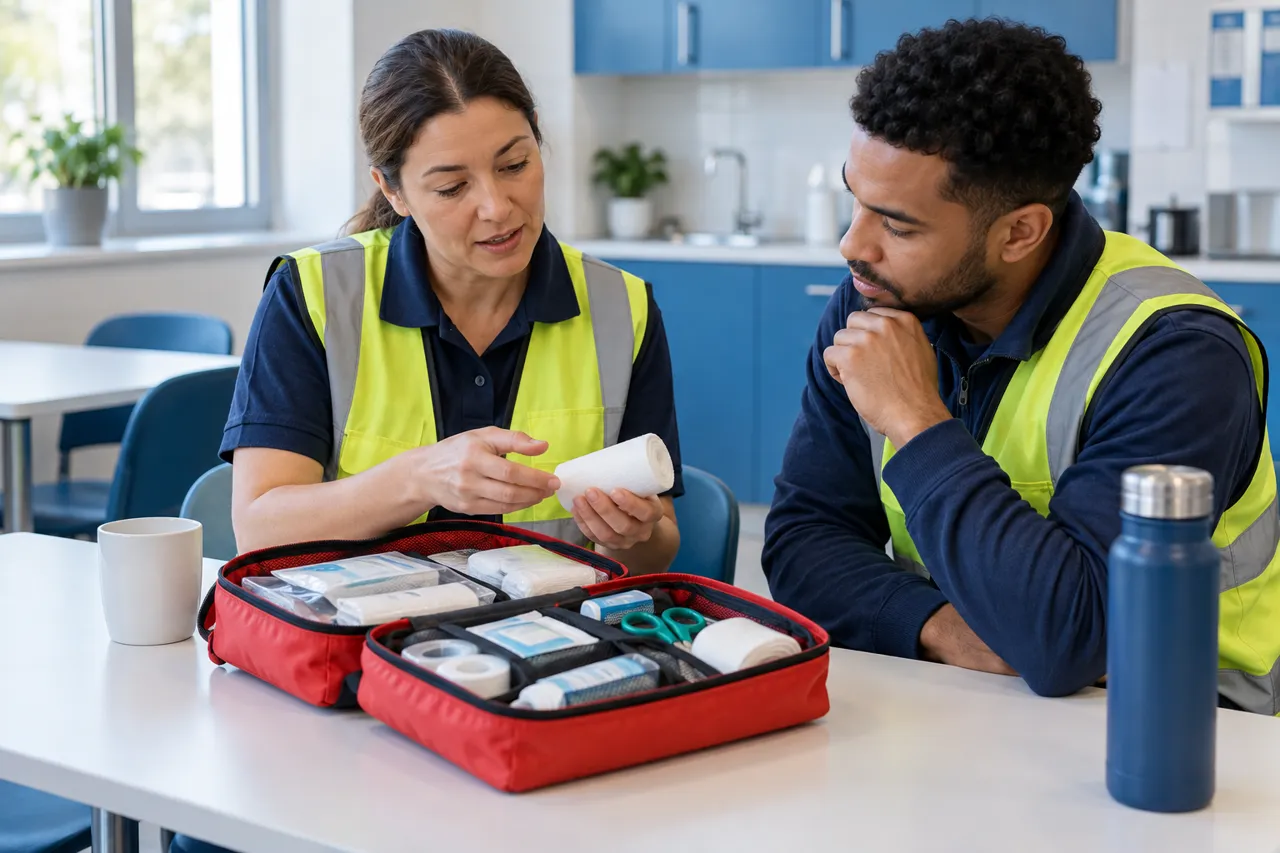
First aid provision follows a needs assessment: the work hazards, workforce size, location, shift cover, absence, visitors and access to emergency services all matter. The outcome may include equipment, trained personnel, an appointed person and facilities appropriate to the circumstances. An appointed person is not automatically a trained first aider. A first-aid box cannot compensate for missing arrangements to summon and guide help. F1
Check that people know how to get assistance, including agency workers and those with limited language proficiency. Review lone and remote work, high-hazard activities and out-of-hours arrangements. Maintain supplies and protect medical confidentiality. Training should fit the needs assessment and remain current. The arrangements should be tested in exercises, but exercises must not introduce unnecessary risk or expose private information.
Well-being also depends on workload, respectful treatment, recovery opportunities and access to support. Avoid presenting a wellness poster as a remedy for inadequate toilets or unsafe work. Distinguish mandatory welfare provision from additional support services. Both may be useful, but they answer different needs.
Safe drinking water and suitable washing facilities should be readily available.Observe: How would you confirm these facilities remain hygienic and accessible?AI-generated fictional learning prompt. The image does not prove organisational performance or compliance.
A welfare justification matrix
Why we study this: The table helps you connect a need to a proposed facility and the evidence for it. Read each row as an argument: this work creates this need, so this provision is justified, subject to these checks.
Facility
Evidence needed
Reasoned question
Toilets and handwashing
Workforce and shift numbers; condition; access
Can every worker use suitable facilities when needed?
Drinking water
Water quality arrangements; location; replenishment
Is water accessible without entering a contaminated area?
Clothing and changing
Work clothing and contamination assessment
Are clean and contaminated items appropriately separated?
Rest and meals
Peak demand; cleanliness; worker feedback
Can people rest and eat without exposure or unreasonable delay?
First aid
Needs assessment; trained cover; emergency access
Is appropriate help available for every working period?
The matrix supports a justification; it is not a checklist of every legal detail. Add the applicable regulation, actual evidence reference, action owner and review date. “Adequate” should be the conclusion of analysis, not a word used instead of analysis.
First aid arrangements include suitable supplies, trained people and clear access.Observe: What would you check beyond the contents of the kit?AI-generated fictional learning prompt. The image does not prove organisational performance or compliance.
Northstar: equal provision across shifts
Why we study this: The fictional case tests the difference between a facility existing and workers being able to use it. Compare the experience of each shift before judging adequacy.
Fictional teaching example: Northstar has 42 workers on the main shift and 18 on the late shift. A shared rest room seats 12, while breaks overlap. The only trained first aider is normally on the main shift. A worker using a mobility aid reports difficulty reaching the washroom. These figures do not establish a legal breach by themselves, but they identify matters requiring prompt assessment and action.
A defensible recommendation would address accessible facilities, first-aid cover during all operations and practical break capacity. Consult the affected worker privately. Review whether staggering breaks provides a workable interim arrangement without reducing rest entitlements or preventing access. Determine whether physical expansion is required. Give priority to essential provision and exposure prevention before decorative refurbishment.
Compare options fairly. A remote temporary facility may be quick to install but poor in bad weather. An accessible permanent refurbishment may better serve long-term needs but require interim provision. Record both the benefit and the dependency. Cost informs how a suitable solution is delivered; it does not justify withholding required facilities.
Practice and self-check
Why we study this: This activity develops a justified welfare decision. The aim is to explain suitability using the workforce and task, not to reproduce a list from memory.
Activity: write a recommendation for Northstar using “because”, “evidence” and “verification”. Model reasoning: provide suitable late-shift first-aid cover because the needs assessment must reflect actual working hours; confirm competence and absence cover through records and exercises; verify that late-shift workers can summon help. Do not prescribe a staffing number without completing the assessment.
Question: why might an apparently clean welfare room still be unsuitable? It may be inaccessible, too small at peak times, contaminated by nearby work or unavailable during a shift. Apply tomorrow: ask workers on a less-visible shift which facility is hardest to use and investigate the answer without treating a single account as the whole picture.
Pause · apply · explain
Make the learning yours
Write your own evidence-based conclusion
Your text stays in this page unless you choose to save it on this device.
Self-recorded study progress, not an assessed pass.
Official assessment criterion Explain the hazards and risks posed by electrics in an organisation
In this lesson
Explain the mechanism, not only the outcome
Why we study this: We first separate the source of danger, the route of exposure and the resulting harm. That sequence makes the explanation useful when someone has to choose a control.
Explain means connect causes, conditions and consequences. Electricity can cause shock, burns, fire, explosion and secondary injuries such as a fall following a shock. Your account should identify where the energy is present, how someone or something can be exposed, and what changes the severity or likelihood. “Electricity is dangerous” does not demonstrate this understanding. EL1, EL2
Voltage is electrical potential difference, measured in volts. Current is the flow of electric charge, measured in amperes. Resistance is opposition to current in a simple resistive model; impedance extends the concept for alternating-current systems. Frequency describes cycles per second. These definitions help explain risk, but an introductory calculation must never be used to predict a safe current through a person.
The effect of shock depends on factors including current magnitude, duration, path through the body, frequency and contact conditions. Wet conditions, damaged skin and conductive surroundings can increase danger. A path across the chest can be particularly serious. Involuntary muscle contraction may prevent release. Contact can also cause burns and loss of balance. There is no appropriate classroom experiment involving people and an electrical supply. EL2
Damaged equipment should be removed from use and assessed by a competent person.Observe: Which visible defects make this cable unsuitable for use?AI-generated fictional learning prompt. The image does not prove organisational performance or compliance.
Direct and indirect contact
Why we study this: Different routes to electrical contact require careful explanation. Studying the distinction helps you describe the actual scenario rather than grouping every electrical concern under one label.
Direct contact concerns touching a part that is normally live. Indirect contact concerns touching an exposed conductive part made live by a fault, such as a metal enclosure following insulation failure. The terms help identify different failure paths, but neither should be assumed harmless because equipment looks intact.
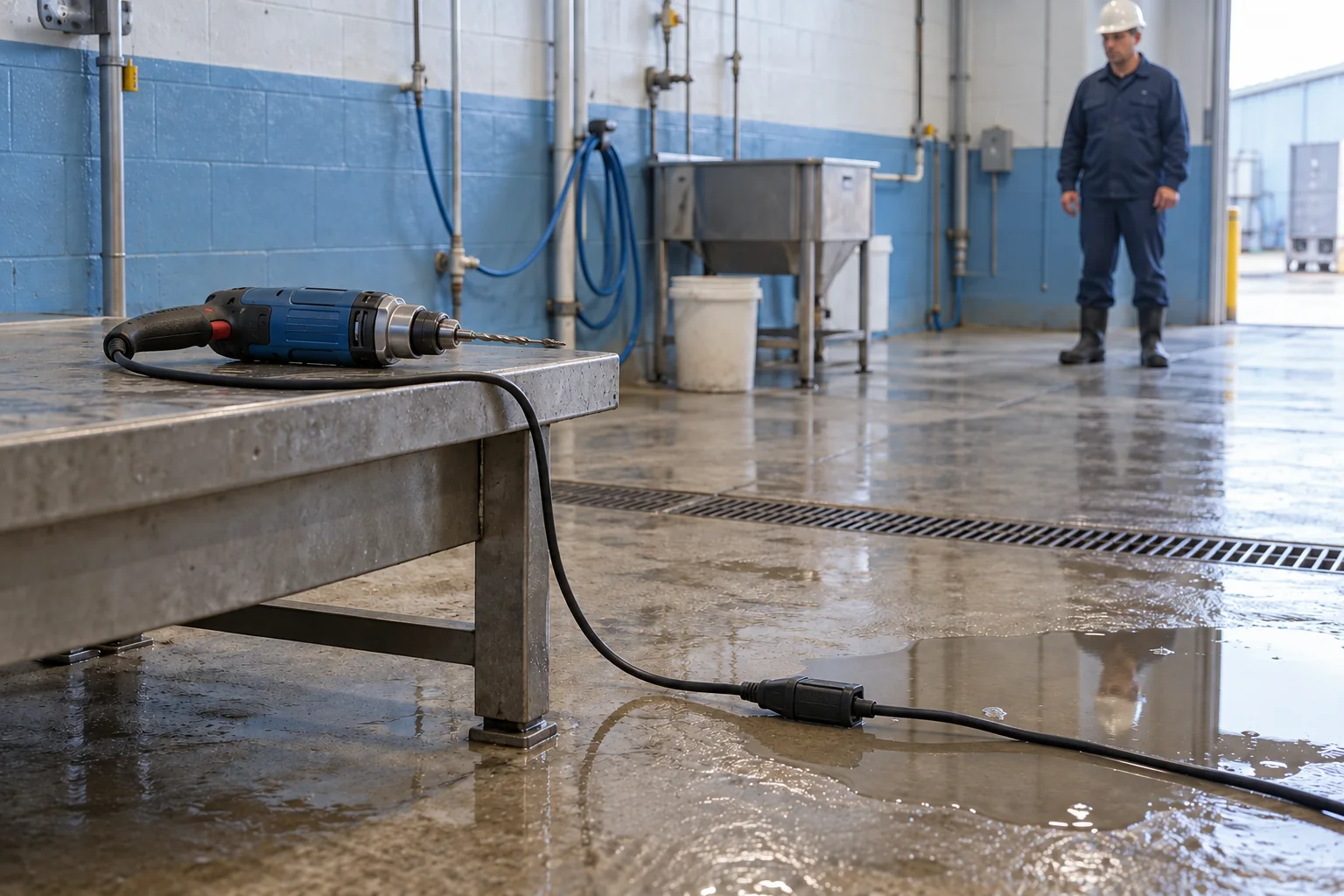
At a maintenance bench, an open enclosure may expose normally live parts. In a warehouse, a damaged cable may energise a metal tool casing. At a temporary worksite, a generator arrangement may introduce earthing and protection issues requiring competent design. The risk assessment must consider the actual supply and installation rather than assuming every portable generator behaves like a fixed mains outlet. EL1, EL3
Water and electrical equipment can create serious risk; access should be controlled.Observe: What needs to happen before this area can safely reopen?AI-generated fictional learning prompt. The image does not prove organisational performance or compliance.
Electrical fire and arc effects
Why we study this: Electrical hazards extend beyond contact with a live part. This topic broadens the mechanism-based explanation so that your assessment does not overlook other harmful effects.
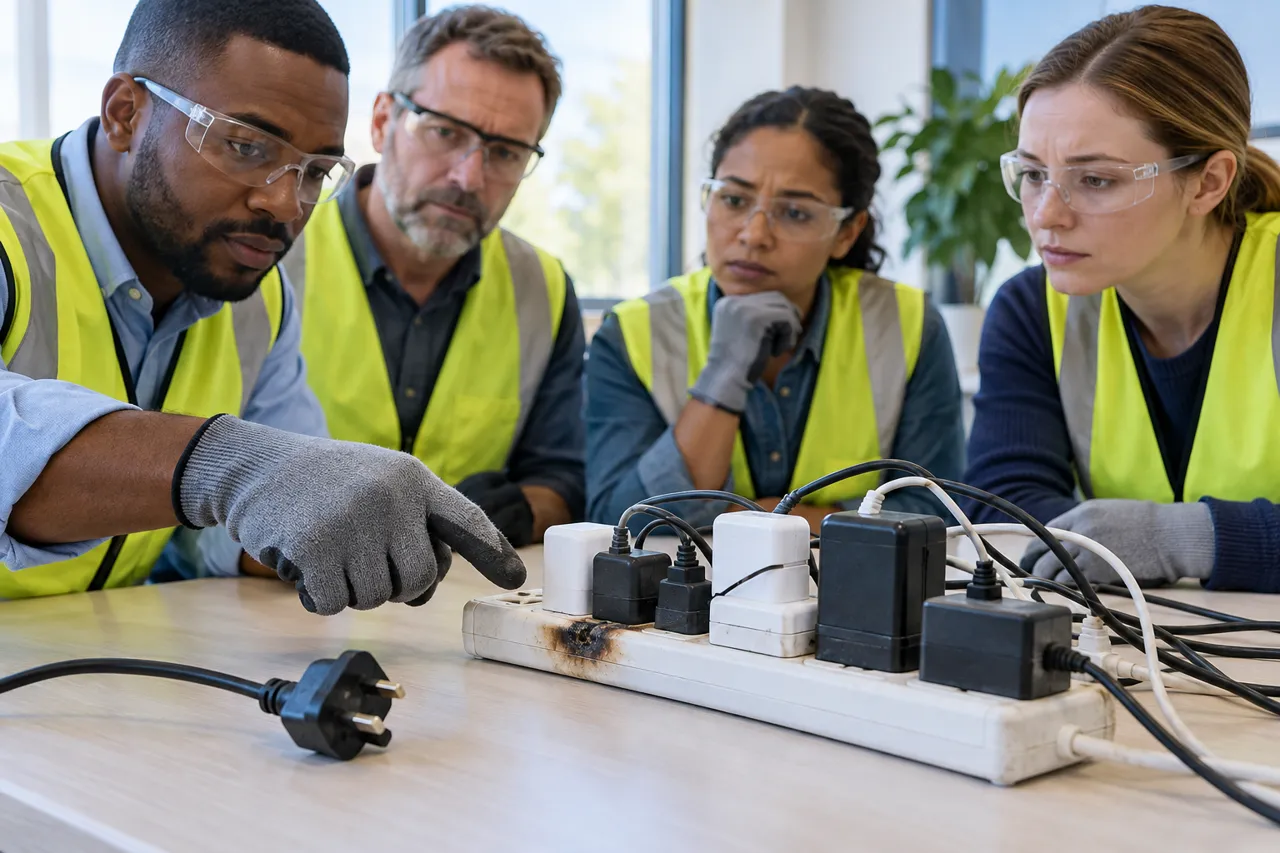
Overloading occurs when electrical demand exceeds what a component can safely carry under its actual conditions. Heating can also arise from poor connections, damage or deterioration. Insulation breakdown may permit faults and ignition. A protective device must be appropriately selected and coordinated with the system; the presence of a fuse does not prove that every foreseeable fault is controlled.
An electrical arc can release intense heat, light, pressure and molten material. Arc-related injury can occur without conventional contact shock. Equipment condition, available fault energy, task and protective arrangements matter. Do not invent a safe approach distance or specify arc-protective clothing from a generic photograph. Competent electrical assessment is required for the actual equipment and work. EL1
Ignition becomes especially important where flammable vapour, gas or combustible dust may be present. A small ignition source can initiate a larger event if the atmosphere and conditions are suitable. Static electricity is charge that accumulates and can discharge. Bonding connects conductive objects to reduce potential differences; earthing provides an appropriate connection to earth. Their design and verification depend on the process and materials. Ordinary earthing arrangements do not automatically resolve every static hazard. D1
Portable equipment, generators and welding
Why we study this: Equipment is used in different places and circumstances. These examples show why protection must match the supply, equipment and task rather than relying on the same assumption everywhere.
Portable equipment is frequently moved, handled, dropped or exposed to moisture. Flexible cables can be crushed, pulled or cut; plugs and sockets can deteriorate. An inspection should consider the conditions of use, user handling and changes since the previous check. A label showing an old test date is not assurance that a cable damaged this morning is safe.
Generators introduce both electrical and non-electrical hazards. Exhaust gases, including carbon monoxide, create a serious risk when fuel-powered generators are used in unsuitable enclosed or poorly ventilated locations. Fuel handling introduces fire risk. Electrical connections, protective arrangements and compatibility with connected equipment require competent planning. Do not improvise connections to a building supply. EL3, C1
Arc welding, including MIG and TIG processes, involves electrical supplies alongside optical radiation, hot work, fumes, gases and sometimes confined or conductive spaces. MIG uses a consumable electrode with shielding gas; TIG uses a non-consumable tungsten electrode with shielding gas. Those descriptions identify processes, not operating instructions. Assess the complete task: electrical shock protection alone will not control welding fume or fire spread. EL1, R1, C2
Overloading and damage require equipment to be taken out of service.Observe: What signs suggest that this arrangement has been unsafe?AI-generated fictional learning prompt. The image does not prove organisational performance or compliance.
Construct a hazard pathway
Why we study this: This exercise connects cause, exposure and consequence. Its purpose is to make a vague concern specific enough that you can identify where a protective measure must act.
Use a simple sequence: source of energy; initiating condition; exposure route; person or property affected; possible consequence; existing safeguards; uncertainty. For example, a flexible cable is crushed by a pallet truck, insulation fails, a worker handles damaged equipment, and shock or burns become possible. The damaged cable is evidence of deterioration; the absence of a reported shock is not evidence of adequate control.
Observation
Possible mechanism
What needs verification
Damaged cable sheath
Conductors may become exposed or protection compromised
Competent inspection and removal from service pending assessment
Water near equipment
Contact conditions and equipment suitability may change
Source of water, equipment rating and protective arrangements
Warm or discoloured connection
Overload, poor connection or deterioration may be present
Safe isolation and competent investigation
Temporary generator
Supply and earthing arrangements may differ
Designed connection, protection, exhaust and fuel controls
The table does not diagnose a fault from appearance alone. It identifies reasons to stop using affected equipment and obtain competent assessment. Untrained people should not open equipment to investigate.
Northstar and professional judgement
Why we study this: Use the fictional evidence to decide what can reasonably be concluded and what remains unknown. The learning target is a justified response, not a confident technical diagnosis without supporting information.
Northstar’s fictional maintenance log contains three cable defects in one month. A supervisor proposes retraining everyone to “take more care”. That may be one element, but first investigate routing, crushing, strain relief, equipment selection, storage and procurement. Repeated damage in the same area suggests a system problem. The strongest explanation connects the defect mechanism to the work arrangement.
Activity: distinguish hazard, exposure and consequence in “a worker uses a damaged grinder in a wet area”. The electrical energy and damaged insulation are hazard-related conditions; handling the tool in those conditions creates the exposure pathway; shock, burns or a secondary fall are possible consequences. More evidence is needed about the actual fault and safeguards, but uncertainty does not justify continued use of obviously damaged equipment.
Apply tomorrow: review how workers report electrical defects and what prevents defective equipment returning to use. A useful control includes a clear stop-use route and repair authorisation, not merely a warning label.
Pause · apply · explain
Make the learning yours
Write your own evidence-based conclusion
Your text stays in this page unless you choose to save it on this device.
Self-recorded study progress, not an assessed pass.
Official assessment criterion Review and evaluate control measures for electrics in relation to current legislation.
In this lesson
From a list of controls to a judgement
Why we study this: Evaluation moves beyond identifying which measures exist to examining whether they work for the particular hazard and task. That is the starting point for evaluating the organisation's arrangements.
Review means examine the arrangements and evidence systematically. Evaluate means judge their adequacy against relevant criteria, identify strengths and limitations and reach a supported conclusion. This criterion requires both, in relation to current legislation. Do not simply name the Electricity at Work Regulations 1989 and assume the task is complete. Explain how the relevant duties connect to the actual system and work. EL2
In Great Britain, the regulations address construction and maintenance of systems, suitability in adverse environments, insulation and protection, earthing or other suitable precautions, excess current protection, isolation, precautions for work made dead, live work restrictions, access and competence. Which provisions apply depends on the facts. Your review should identify the installation, equipment, people, task and operating conditions before judging arrangements.
Review the arrangements, then test the evidence
Why this image matters
The plan is a starting point for evaluation. Compare the proposed controls with the actual task, equipment, environment and competence needed; a completed document alone cannot demonstrate effective protection.
Discuss: What would you check on site before accepting the planned controls?
Why we study this: A reminder to be careful is not the whole design of protection. This topic helps you examine options that act on the hazard and exposure before placing reliance on what people must remember to do.
Start by avoiding the hazardous task or eliminating exposure where practicable. Select suitable equipment and a safer method. Arrange effective isolation and prevent unintended re-energisation for work that should be performed dead. Engineering protection, enclosure and appropriate system design provide stronger protection than telling people to be careful. Procedures, supervision and personal protection support the system but do not replace suitable equipment and isolation. EL1
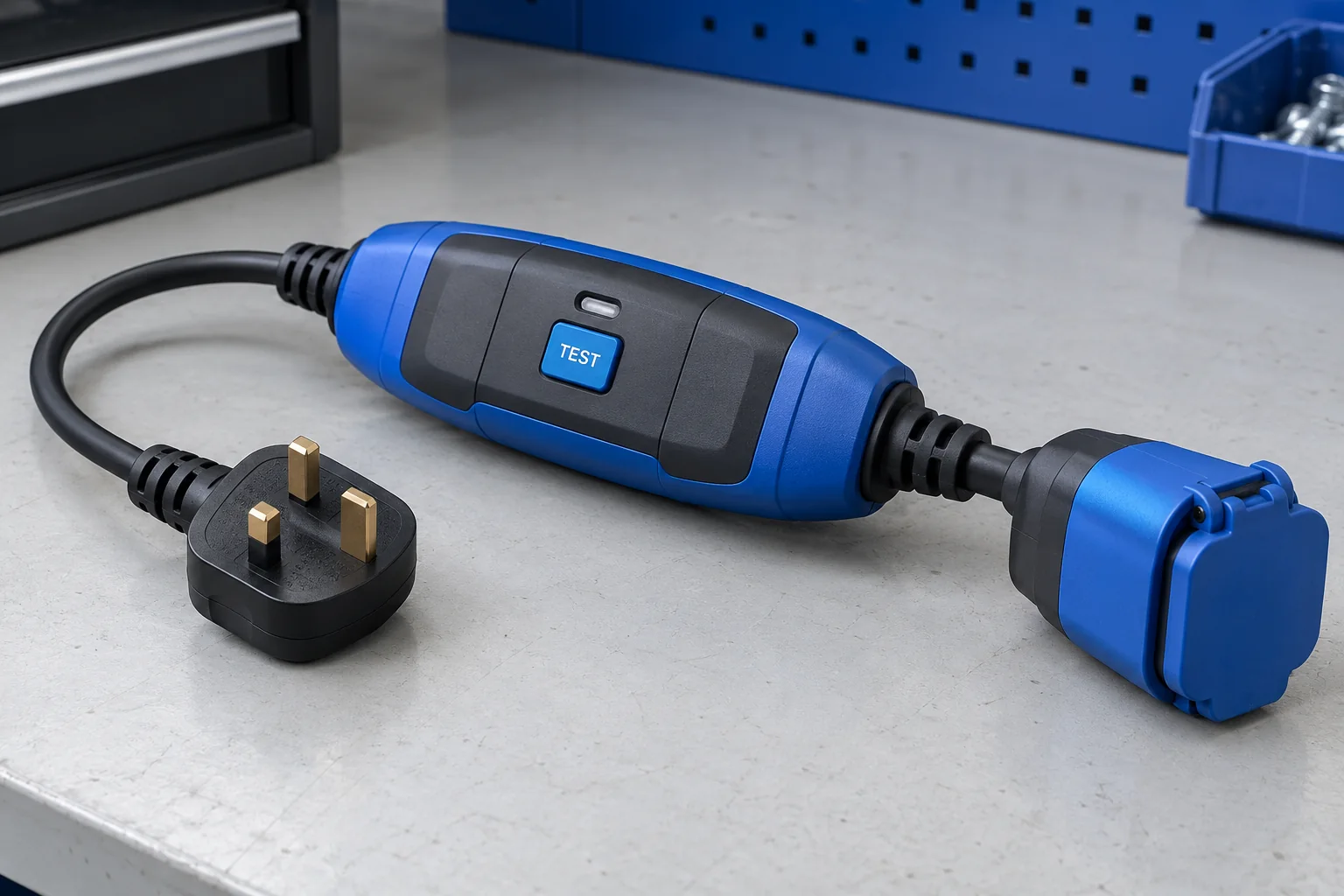
A residual current device, or RCD, detects an imbalance in current and disconnects under specified conditions. It can provide additional protection, but it does not protect against every shock mechanism or make live work safe. A fuse or circuit breaker principally provides selected overcurrent protection. Double insulation is a protective construction arrangement; it is not simply a plastic-looking case. Reduced voltage can reduce some risks, but supply configuration and other hazards still matter. EL2, EL3
Control selection is task-specific. Equipment suitable in a dry office may be unsuitable in a wet, corrosive or explosive environment. Look at ingress protection, mechanical strength, temperature, cable routing, connectors and manufacturer limitations. Route cables to avoid mechanical damage and tripping, with suitable protection where routes cross. Height alone is not a universal rule: overhead routing can introduce other hazards or conflict with equipment movement.
Choose controls for the environment
Why this image matters
Water can increase electrical risk. Equipment and connections must suit the conditions. Review the work method and equipment selection instead of relying only on reminders to be careful.
Discuss: Which changes could prevent the equipment and connections being exposed to water?
RCD means residual current device. It detects a specified current imbalance and disconnects the supply. It provides additional protection, but does not prevent every electric shock or make damaged equipment safe.
Discuss: Why would an RCD be insufficient as the only response to the wet-area scene above?
Fictional teaching scene. An image does not establish workplace condition or compliance. Device appearance varies. This illustration does not establish product suitability or performance. HSE electrical equipment guidance.
Safe systems for work made dead
Why we study this: Maintenance can change the conditions that protect people during ordinary use. Understanding the logic of controlled electrical work helps you evaluate arrangements and recognise why competent planning and verification matter.
The management principle is that electrical work should be carried out dead wherever possible. A competent person must identify all relevant supplies, isolate, secure against re-energisation and verify the safe condition using appropriate methods and equipment. Stored energy and alternative supplies must be considered. A normal stop button, software command or open switch is not automatically secure isolation. EL1
This book teaches oversight, not a do-it-yourself isolation procedure. A manager should verify that the organisation has a suitable safe system, authorised competent people, appropriate equipment, clear boundaries, communications and handback arrangements. A permit-to-work is a formal control of particular high-risk work. It is not proof that isolation occurred, and a signature cannot substitute for the physical precautions.
Live working is subject to strict legal conditions. Convenience, production pressure or a routine preference does not by itself justify it. In Great Britain, the conditions in regulation 14 must all be satisfied, including that it is unreasonable in all the circumstances for the conductor to be dead, reasonable for the person to work on or near it while live, and suitable precautions are taken. Seek competent electrical advice rather than treating this wording as a general permission. EL2
A lock belongs within a safe system
Why this image matters
The lock illustrates one part of controlled electrical work. Competent people must address relevant supplies, prevent re-energisation and verify the safe condition. A photograph cannot establish that these steps occurred.
Discuss: What evidence would confirm the safe system, responsibilities and handback arrangements?
Fictional teaching scene. An image does not establish workplace condition or compliance. HSE safe working practices.
Inspection, testing and maintenance
Why we study this: Electrical conditions can deteriorate after equipment is purchased or checked. This topic explains why continued use needs a suitable maintenance arrangement and a reliable response to newly found defects.
User checks, formal visual inspection and electrical testing contribute different evidence. A user may notice damage before use. A formal inspection is more systematic. Testing can identify defects that visual examination cannot, but only when the right tests are performed and interpreted competently. Testing itself can introduce hazards and must be controlled.
There is no blanket legal requirement for every portable appliance to receive an annual PAT test. Maintenance arrangements and frequencies should reflect equipment type, use, environment, defect history and manufacturer information. PAT is the familiar abbreviation for portable appliance testing, not the name of the whole management system. Record what was examined, by whom, with what result and what action followed. EL4
Evaluate both completion and effectiveness. A 100% inspection completion rate may coexist with repeated damage because the chosen interval is too long or the equipment is unsuitable. Sampling can help a management audit, but it does not excuse ignoring a known defect. Track repeat findings, overdue critical actions and the time between defect report and effective removal from use.
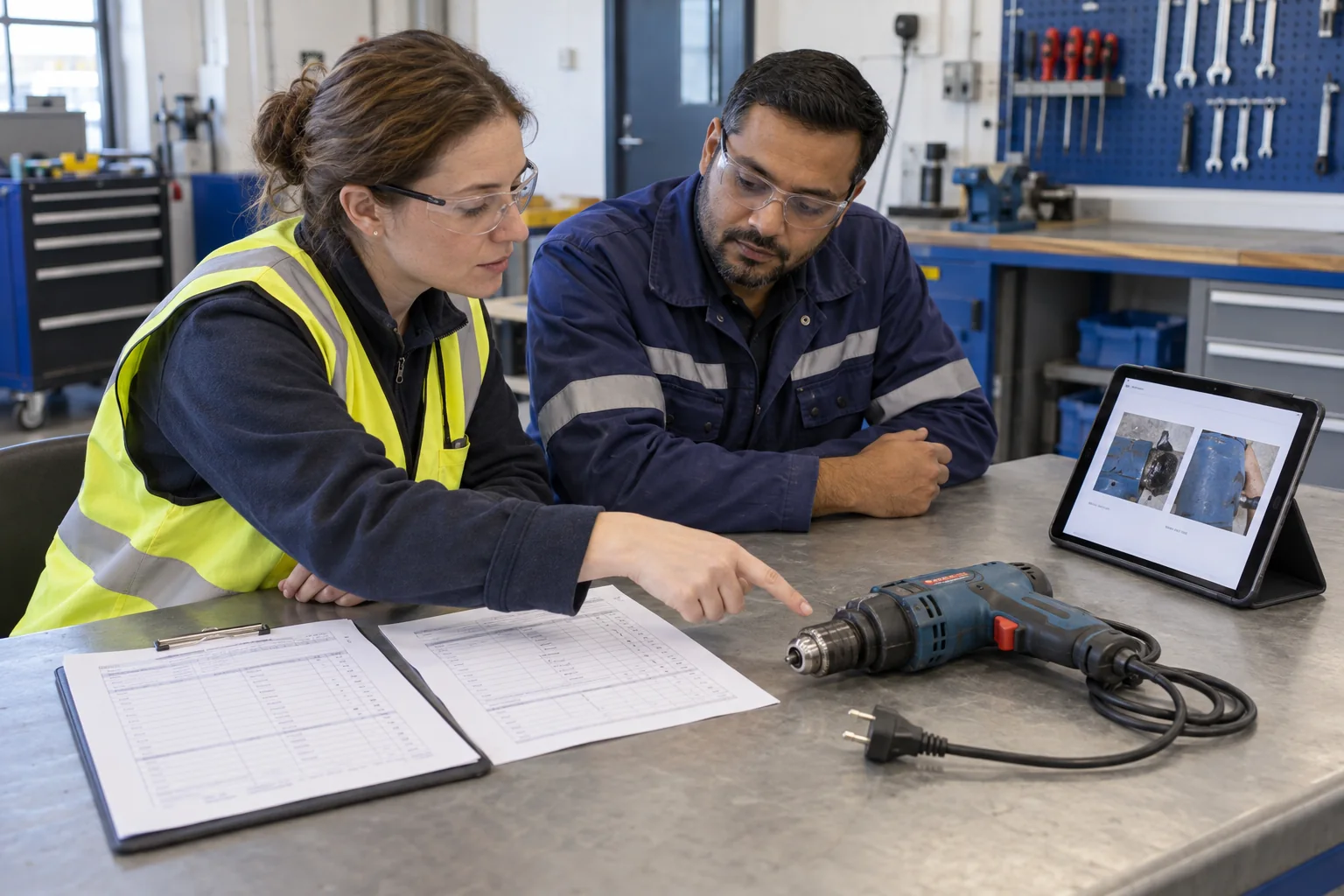
Inspect, report and act on defects
Why this image matters
Visual checks can reveal damage, while suitable testing provides other evidence. The important next step is effective action: record the defect, stop unsafe use and arrange competent assessment or repair.
Discuss: Why does a previous test result not guarantee the condition of this cable today?
Why we study this: The table separates an arrangement from the evidence of its performance. Use it to explain what each record shows, what it does not establish and what further check would support a conclusion.
Completion alone does not prove defects were resolved
Competence
Task-specific assessment, experience, supervision
A course certificate may not cover this installation
Emergency arrangements
Isolation access, response plan, exercises
Workers may know a procedure but be unable to act safely
Write an evaluation in the form: criterion; evidence; strength; gap; significance; action; verification. State the extent of your review. “The sampled records support…” is more accurate than “all electrical equipment is safe” when only a small sample was examined.
Compare the record with the equipment
Why this image matters
A record supports a judgement only within its scope. Compare what was inspected, what was found and what action followed with the equipment and conditions now present.
Discuss: Which part of the evidence table would this scene help you investigate, and what would remain unproven?
Why we study this: Several responses may sound reasonable. The case asks you to compare them with the mechanism of harm and the available evidence so that your recommendation addresses the problem identified.
Fictional teaching example: Northstar completes all scheduled annual tests, but cables crossing a dispatch route are damaged repeatedly. The test programme is a strength in planned maintenance, but it is not preventing the known damage mechanism. Isolate and remove defective items, obtain competent advice on rerouting or an appropriate alternative supply arrangement, and review inspection frequency in light of use. Train workers on reporting and stop-use arrangements as part of the wider change.
A recommendation to “test every month” may increase detection but leave the source of damage intact. A stronger evaluation compares prevention, detection and response. It also considers whether the proposed rerouting introduces trip, access or vehicle-clearance problems. Verify the intervention through observations during busy dispatch periods and a review of subsequent defects.
Activity: a contractor says an RCD allows them to work live without isolation. Explain why that is inadequate. Discussion: an RCD provides only particular protection; live work requires the statutory conditions and suitable precautions, assessed by competent people. The appropriate management response is to stop the unsupported arrangement and require a justified safe system.
Apply tomorrow: select one recurring electrical defect and trace it from report to removal, repair, authorisation and return to service. Identify where accountability could be lost.
Northstar: prevent recurring cargo-route damage
Why this image matters
Cargo movement can damage insulation. Repeated testing may detect damage without preventing it. Compare safer routing or supply arrangements, defect reporting and the response to unsafe equipment.
Discuss: What would prevent recurrence, and how would you check that the change worked?
Official assessment criterion Assess the hazards and risks associated with the structural integrity of buildings.
In this lesson
What structural integrity means
Why we study this: Start with what the structure is required to do. Understanding its function provides the basis for asking whether its condition and loading remain suitable.
Structural integrity is the ability of a structure to support the loads and conditions for which it must perform without unacceptable failure. A building carries its own weight, people, stored materials, equipment and environmental loads through a connected load path to the ground. A load path is the route by which forces are transferred through slabs, beams, columns, walls, connections and foundations. Changing one element can affect others. B1, B2
Assess means examine hazards, people exposed, existing safeguards, the quality of evidence and the significance of remaining risk. A health and safety practitioner can identify warning signs, control access and commission specialist assessment. They should not certify structural capacity from a photograph, invent permissible crack widths or design temporary support without appropriate engineering competence.
Recognise a concern without guessing capacity
Why this image matters
The crack is an observation, not a diagnosis. Structural integrity concerns how the building carries its loads. The scene prompts questions for competent assessment; it does not establish remaining capacity.
Discuss: What can you observe, and which conclusions require engineering evidence?
Fictional teaching scene. An image does not establish workplace condition or compliance. The safe stand-off distance must follow the actual hazard assessment; it cannot be judged from this image. HSE structural stability guidance.
How deterioration and change create risk
Why we study this: The past use of a building does not describe every future demand on it. This topic helps you notice changes in condition, loads or use that should trigger a further assessment.
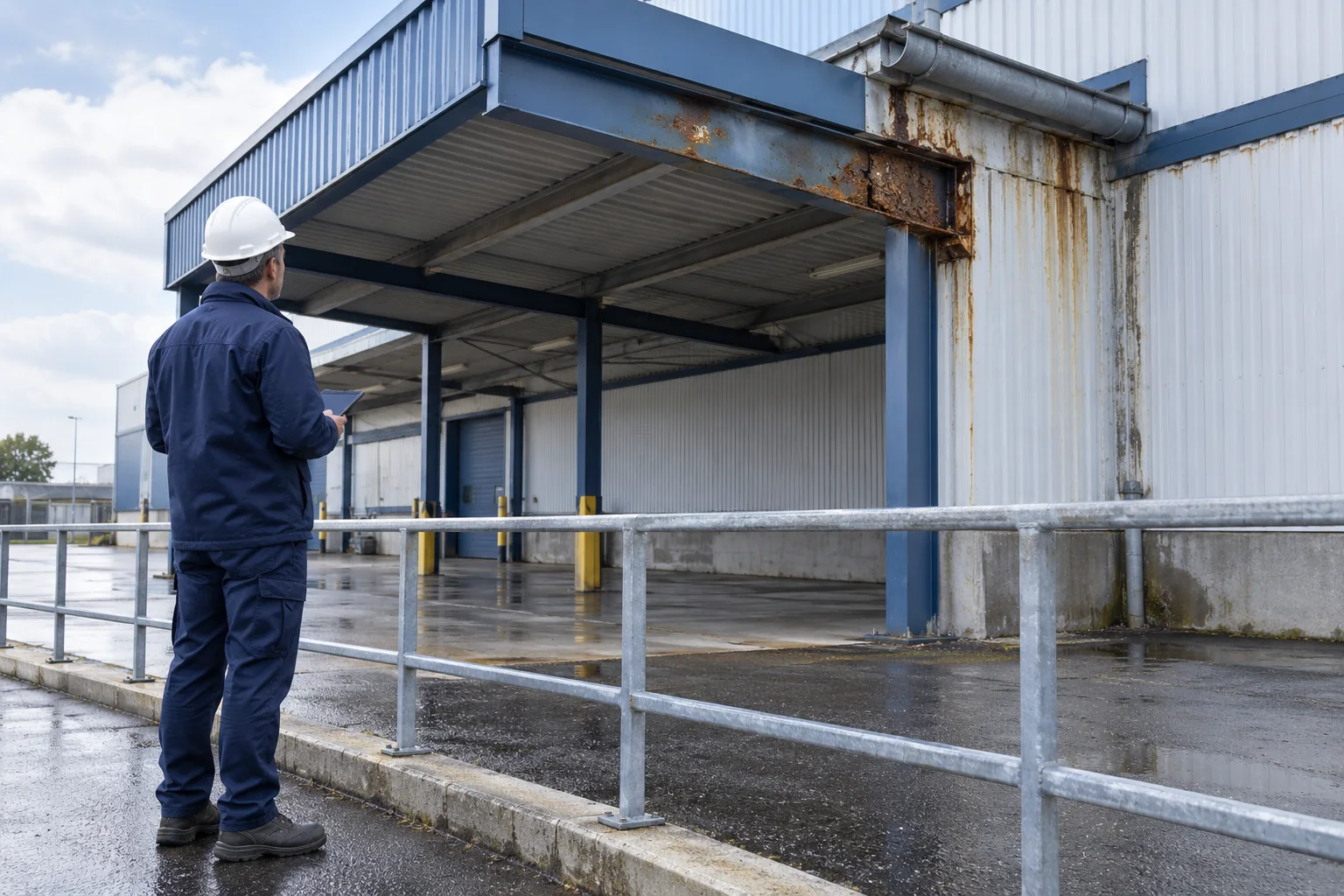
Adverse weather may damage roof coverings, cladding, drainage, fixings and exposed structures. Wind, snow, water accumulation and temperature effects must be considered in the actual design context. A blocked drain can add load and accelerate deterioration. Corrosion can reduce the effective section of metal components; heat or fire can alter material performance and damage connections. Appearance alone may underestimate hidden deterioration. B2
Overloading occurs when imposed demands exceed the suitable capacity of the structure or component. A floor’s overall load limit may not describe a concentrated machine load or rack-leg reaction. Dynamic loads from moving equipment can differ from static loads. Vibration can affect fatigue, connections or adjacent structures. Assess proposed use against verified design information rather than assuming that a floor supporting one arrangement will support every replacement.
Alterations to structural members can interrupt the load path. Removing a wall, cutting an opening, drilling through a member or adding a mezzanine may have consequences beyond the immediate work area. Subsidence is downward movement of the ground supporting a structure; differential movement can distort it. Poor design, substandard workmanship and missing information can create vulnerabilities even where no deterioration is visible.
Deterioration changes the assessment
Why this image matters
Weather exposure, water and corrosion can change structural condition. Assess changes in use and loading alongside deterioration; a familiar building may no longer match the assumptions behind its original design.
Discuss: Which observations and records would you refer to a competent structural specialist?
Why we study this: You may see a concern before its cause is known. Here the purpose is to recognise the need for a protective response and competent advice without presenting an observation as a confirmed diagnosis.
Possible warning signs include new or changing cracks, unusual deflection, leaning, corrosion, spalling concrete, damaged connections, water ingress, unexpected movement, impact damage and unusual sounds. They are prompts for investigation, not a remote diagnosis. Consider the location, change over time, loading history and whether people are exposed to falling material or collapse.
Where credible evidence suggests instability or falling-object danger, protect people first. Restrict access to a proportionate area, prevent additional loading or disturbing work and arrange competent engineering assessment. Do not send someone underneath a suspect area to obtain a better photograph. Barriers should reflect the potential collapse or fall zone, with specialist advice where required. B1
An emergency response may include evacuation and contacting emergency services. It should be triggered by the actual conditions and organisational arrangements, not delayed until a risk score can be calculated. A low score cannot neutralise credible potential for catastrophic failure with insufficient evidence of stability.
Protect people while the concern is assessed
Why this image matters
A rack that remains standing may still be damaged. Control access, report the concern and arrange competent assessment. Do not improvise unloading or repairs that could worsen instability.
Discuss: Who could still be exposed, and are the access controls adequate for the possible consequences?
Fictional teaching scene. An image does not establish workplace condition or compliance. HSE warehousing guidance.
Building an evidence-based assessment
Why we study this: The next step is to organise observations, records and specialist input into a defensible judgement. We study evidence quality because an incomplete record can support only a limited conclusion.
Gather drawings, structural calculations where available, maintenance records, inspection reports, alterations, impact incidents, loading schedules and relevant ground information. Check whether records describe the current building. An old drawing may omit later penetrations or additions. Speak to maintenance staff and users, who may notice changes that do not appear in formal records.
Record observations with dates, locations and an appropriate scale, from a safe position. Distinguish observation from interpretation: “a visible crack above the doorway” is an observation; “foundation failure” is a diagnosis that needs evidence. Track change only under a competent monitoring plan. Monitoring is not an acceptable substitute for immediate protection where the structure may be unsafe.
Identify people exposed during normal use, deliveries, cleaning, roof maintenance, contractor work and emergencies. Include neighbouring premises and the public where relevant. Consider failure consequences, the reliability of current controls and uncertainty. Set a clear referral threshold: what finding triggers engineering review, restriction, evacuation or a hold on planned changes?
Bring records and observations together
Why this image matters
Check that drawings and records describe the building as it is now. Combine them with dated observations and specialist input, keeping visible facts separate from assumptions about their cause.
Discuss: How would you find out whether these drawings include later alterations?
Northstar: the damaged rack and proposed mezzanine
Why we study this: This fictional comparison brings together an existing defect and a planned change. It helps you distinguish immediate response from the evidence and approval needed before a new arrangement is introduced.
Fictional teaching example: a vehicle strikes a rack upright. The driver reports it, and a manager suggests painting over the mark because the rack is still standing. The correct first judgement is that continued standing does not demonstrate retained capacity. Restrict the affected area and obtain competent racking assessment under the site’s arrangements. Do not improvise unloading where that activity could destabilise the rack.
The proposed mezzanine creates a separate assessment. Ask what load it introduces, how that load reaches foundations, whether existing services or fire arrangements are affected, and whether construction changes the stability of the building. Capacity and regulatory approvals require the appropriate designers and authorities. Health and safety management coordinates information, interfaces and precautions; it does not replace engineering design.
Evidence
What it helps establish
What it cannot establish alone
Current structural drawings
Intended arrangement and load paths
Present condition or unrecorded alterations
Dated damage observations
Location and change
Remaining load-bearing capacity
Engineering assessment
Condition, significance and specified action
Continued compliance after later unauthorised change
Maintenance records
Known defects and action history
Absence of defects that were never reported
Northstar: assess the proposed mezzanine
Why this image matters
A proposed mezzanine changes the loading and may affect other systems. Before work starts, obtain competent design review of the load path, existing structure and relevant interfaces and approvals.
Discuss: What information must be available before this proposal can progress?
Why we study this: Use this exercise to explain both your conclusion and its limits. A sound structural assessment identifies the next competent decision needed, rather than guessing at a structure's capacity.
Activity: write a three-part response to a new ceiling deflection after heavy rain. Discussion: protect people from the suspect area; report and obtain competent assessment, including water accumulation and loading; retain a clear record of restrictions and conditions for safe reoccupation. Do not instruct staff to climb onto a roof to clear water without an assessed safe system.
A justified conclusion states both what is known and what remains uncertain. “The available evidence is insufficient to confirm safe continued use of the affected bay; access remains restricted pending competent assessment” can be more professionally sound than an unsupported declaration of safety. Apply tomorrow: check who must approve structural alterations and whether operations know that apparently small changes can require review.
Respond to the change, then establish the cause
Why this image matters
New deflection after rain needs a protective response and competent assessment. State what is known, restrict exposure where necessary and obtain advice; uncertainty is not evidence that continued use is safe.
Discuss: How would you explain the immediate action, evidence gap and conditions for reopening?
Evaluating structural controls and legal arrangements
Official assessment criterion Review and evaluate control measures for structural integrity in relation to current legislation.
In this lesson
Evaluate the management system around the structure
Why we study this: Individual inspections only help when the organisation acts on their findings. This topic asks who makes decisions, closes defects and checks whether a structure remains suitable for its use.
This criterion moves from recognising structural risk to judging whether controls are adequate in relation to applicable law. In Great Britain, workplace maintenance and stability duties may arise under the Workplace Regulations and general health and safety duties. Construction, alteration and demolition can bring the Construction (Design and Management) Regulations 2015 into scope. Building regulations and specialist building-safety regimes have their own application. Do not treat every workplace as if the same detailed building regime applies. W1, B1, B3
Begin by defining the premises, occupancy, ownership and control. In leased premises, identify the landlord’s and occupier’s responsibilities, while recognising that a lease does not simply remove statutory duties. Shared buildings need coordination. A repair request sent to a landlord is evidence of communication, not proof that the hazard is controlled in the meantime.
Who turns the roof concern into action?
Why this image matters
Observation must lead to a managed response. Identify who controls access, arranges competent assessment and follows up the finding. A report sent to another party does not itself control exposure.
Discuss: If the usual facilities contact is unavailable, who has authority to act?
Why we study this: A change can create a problem before deterioration is visible. Prevention begins at the planning stage so that suitability, interfaces and responsibilities are examined before work proceeds.
Prevention starts with suitable design, competent construction and verified suitability for the intended use. After occupation, proposed changes must be assessed before implementation. A management-of-change process records the proposal, affected structure, design review, necessary approvals, temporary precautions, construction method, inspection and handover. “It is only a small opening” is not an adequate engineering justification.
The process should also cover operational changes: denser storage, heavier equipment, new vibration sources, corrosive processes and altered drainage. A procurement team may introduce a structural issue before a safety team hears about it. Include facilities, operations, engineering and purchasing in the change route, with responsibility for maintaining accurate drawings and load information.
Where temporary works support construction or an existing structure, they must be properly designed, checked and managed for the actual conditions. Temporary does not mean informal. Scaffolding is not automatically structural support; it must be specifically designed for that purpose if it is to support a structure. Changes to a sequence of work can change stability and must be reviewed. B1
Review the change before authorising work
Why this image matters
Controlled change connects the proposal with design review, responsibilities and the precautions needed during the work. Check structural and operational effects before accepting a change as minor.
Discuss: Which approvals, temporary arrangements and handover evidence would you expect?
Why we study this: Identifying a defect is the start of a response, not its completion. Here you learn to examine how findings lead to action and how unresolved concerns reach someone able to decide.
An inspection programme should reflect condition, exposure, use, consequences of failure and specialist recommendations. Routine observations by users, planned maintenance inspections and specialist structural assessments are different layers. Do not invent a universal annual interval for every building. Define scope, competence, findings, escalation criteria and follow-up.
Trigger additional review after impacts, severe weather, fire, flooding, unexpected movement, significant corrosion or unauthorised alterations. A calendar-based inspection does not justify waiting when a new event has changed the conditions. Maintain drainage, roof coverings, fixings and protective coatings where they contribute to integrity. Ensure maintenance tasks themselves have safe access and work arrangements.
Action closure must be evidence-based. A work order marked complete may mean a contractor attended, not that the specified repair was verified. Require appropriate inspection, documentation and authorisation before restrictions are removed. Retain limitations: a temporary repair may require monitoring, load restrictions or a permanent follow-up solution.
Escalate the finding and track the response
Why this image matters
Reporting begins the response. Maintain necessary restrictions and identify who is responsible for the next decision and what specialist advice they need. A new impact cannot simply wait for the next scheduled inspection.
Discuss: What should the report contain, and who will verify that the action has achieved the required result?
Fictional teaching scene. An image does not establish workplace condition or compliance. HSE warehousing guidance.
Governance and assurance
Why we study this: Governance means the arrangements for directing decisions and accountability; assurance means obtaining evidence that those arrangements work. These ideas help you evaluate whether structural responsibilities remain clear over time.
Governance is the arrangement for decisions, authority and accountability. Name who can stop use, commission an engineer, approve expenditure, authorise alterations and permit reoccupation. Give operations a clear escalation route when responsible people are unavailable. Contractor competence should match the work, with suitable design and inspection capability rather than an unrelated general certificate.
Assurance means obtaining reliable evidence that the system works. Review whether the register includes all buildings and structures, whether overdue high-priority actions are visible, and whether changes are captured. Sample a completed repair from the original finding through specification, execution and verification. Speak to users about reporting barriers and check whether warnings are removed only after authorised release.
Make authority and accountability clear
Why this image matters
Governance makes decisions and responsibilities clear. Use the scene to identify who can restrict use, commission expertise, approve resources and authorise reopening—and how those decisions will be checked.
Discuss: Which decision would become unsafe or delayed if everyone assumed someone else owned it?
Why we study this: We bring the system and its evidence together in one example. The purpose is to practise distinguishing completed activity from a verified result.
Fictional Northstar evidence: quarterly facilities checks exist, but the mezzanine proposal bypassed engineering review and two rack-impact reports lack closure evidence. The scheduled checks are a strength, yet the change and defect-management arrangements are weak. Prioritise restriction and competent assessment of affected racks, a hold on the mezzanine change, and a documented approval route for future structural or loading changes.
Do not conclude that the entire organisation is non-compliant from two observations without establishing the relevant facts and duties. Equally, do not allow uncertainty about legal classification to delay protection from a credible hazard. Separate the immediate safety decision from the subsequent legal and technical evaluation.
Evaluation element
Strong evidence
Weak substitute
Change approval
Current design review and authorised conditions
Verbal reassurance that similar work happened before
Defect control
Restricted area, competent assessment and tracked action
A warning sign without control of access
Repair closure
Verification against the specified repair
An invoice or attendance note alone
Continued suitability
Load/use review and inspection after change
Original approval with no review of later alterations
Northstar: verify the result before closing the action
Why this image matters
An invoice records a transaction, not necessarily a satisfactory repair. Compare the result with the specified work, confirm any limitations and obtain the appropriate authorisation before removing restrictions.
Discuss: What evidence would you require before marking this corrective action complete?
Fictional teaching scene. An image does not establish workplace condition or compliance. HSE warehousing guidance.
Section 1 synthesis
Why we study this: Step back from the six criteria and examine the workplace as one connected system. This closing exercise checks whether you can link conditions, welfare, energy and structure in a coherent professional judgement.
Workplace conditions, welfare, electrical safety and structural integrity share one principle: actual use must match the assumptions behind protection. If the work changes, review the assumptions. If evidence is weak, state the uncertainty and obtain the right expertise. If there is immediate danger, protect people before completing the paperwork.
Final activity: present a five-minute management briefing for Northstar. State the immediate actions, three evidence gaps, the responsible specialists and how effectiveness will be checked. Use plain language and distinguish observations from conclusions. A strong response explains why a cable rerouting project and a structural restriction cannot be replaced by a general safety talk.
Apply tomorrow: choose one completed corrective action and verify its result with the people who use the workplace. Ask not only “Was it done?” but “Did it solve the problem without creating another one?”
Connect the hazards in one professional briefing
Why this image matters
Use the scene to practise a concise briefing that links workplace conditions, electrical controls and structural concerns. Explain priorities, missing evidence, responsible specialists and how results will be verified.
Discuss: How would you turn these findings into a five-minute management briefing?
Fictional teaching scene. An image does not establish workplace condition or compliance.
Pause · apply · explain
Make the learning yours
Write your own evidence-based conclusion
Your text stays in this page unless you choose to save it on this device.
Self-recorded study progress, not an assessed pass.
Northstar has glare at a bench, gaps in late-shift welfare, recurring cable damage and an impacted rack. All information is fictional teaching data.
Your management briefing
Compare your reasoning with the discussion
Protect people from the affected electrical and structural hazards first. Obtain competent assessment; do not use an old test label or the absence of collapse as reassurance. Examine glare during the actual task, and assess welfare and first-aid arrangements across shifts. Assign operations, facilities and engineering responsibilities. Verify the result before closing actions.
A strong answer distinguishes fact from assumption, explains the mechanism, recognises competence limits, and gives a clear check of effectiveness. There is no automatic grading of your written work.
Primary guidance for learning and professional verification. References were checked for this edition on 24 September 2026. Some linked publications have older publication dates. Always check applicability and current amendments before a workplace decision.

 Campus ↗