LO · Learning Outcome
The capability you should demonstrate by completing the learning.
DB HSE International · Free OTHM Level 6 workshop
Explore the OTHM Level 6 Diploma in Occupational Health and Safety.
Our OTHM Level 6 training journey began in 2022. Since then, DB HSE International has trained over 100 learners, including retired British Army personnel, directors, CEOs and recognised professionals.

Understand the programme
Connect the purpose, qualification structure and assignment expectations before exploring each unit.
The purpose
Health and safety professionals need to connect policy with what people actually experience at work. A procedure may look convincing, yet its effectiveness depends on resources, supervision, communication and the conditions in which it is used.
This workshop introduces the qualification and a practical approach to learning. As you study, ask three questions: What does this mean? How would it work here? What evidence would justify my decision? Those questions help you move beyond remembering definitions towards explaining and evaluating professional practice.
Build a reasoned connection between a workplace problem, reliable evidence, suitable action and a way to check the result. The unit lessons develop this in greater depth.
The qualification
The official title is OTHM Level 6 Diploma in Occupational Health and Safety, qualification number 603/5002/7.
TQT includes the estimated overall learning and assessment effort. GLH covers guided learning; it is part of TQT. A credit represents learning volume, not a grade. The qualification is assessed through assignments and evidence portfolios, with Pass/Fail grading.
Official reference: OTHM specification, updated December 2023, pages 4–6 and 8.
Every prospective learner should have their qualifications, relevant practical experience and English competency checked by the centre against OTHM’s entry requirements. The specification includes recognised health and safety qualifications and consideration of mature applicants with relevant experience. A free workshop place does not confirm eligibility for the diploma.
Read OTHM’s entry requirements and ask DB HSE International to review your documents.
Level describes the demand of the learning. It does not make this diploma a bachelor’s degree or guarantee university admission, employment or professional membership. The specification describes eligibility to apply for CertIOSH subject to experiential criteria; the relevant professional body’s current requirements must be checked.
DB HSE International’s planned completion timeline:
Completion depends on submitting all required assignments, meeting the assessment requirements and, where applicable, completing the agreed instalment payment plan.
The process may move more quickly or take longer depending on individual progress and circumstances. Assignment revisions, incomplete payments or other concerns may extend the timeline beyond the indicative upper range. Please discuss any changes to your completion plan with DB HSE International.
These are DB HSE International’s delivery estimates, not official OTHM duration requirements or guaranteed completion or certification dates.
Prepare your assignment
The capability you should demonstrate by completing the learning.
The specific requirement against which your submitted work is assessed.
Topics supporting the learning outcome. Content may be shared across criteria; do not assume a separate one-to-one mapping.
Start with your centre-issued assignment brief and current unit specification. Read the task, the command word and every relevant criterion together. Completing an LMS exercise records practice, not an assessed pass. OTHM requires the learning outcomes and assessment criteria to be met; centres assess and OTHM externally verifies.
OTHM assessment and verification, page 8.
Show how something works and why. Link the process with its purpose and consequences.
Examine causes, parts and relationships. Show how the evidence supports your interpretation.
Weigh strengths, weaknesses and uncertainty, then justify your judgement against suitable criteria.
These are practical writing explanations, not replacement assessment instructions. Follow the precise command words in your brief. More pages alone do not demonstrate a stronger answer; a relevant argument supported by evidence does.
| Requirement | Evidence to consider | Reasoning to include | Self-check |
|---|---|---|---|
| Your exact AC and command word | Relevant records, anonymised observations and authoritative guidance | What the evidence shows; its limitations; how it supports the answer | Have I answered the criterion rather than only described the topic? |
Teaching scenario: fewer reports might reflect better conditions, less work, changed reporting arrangements or reluctance to report. Examine the reporting process, worker testimony, exposure hours and inspection findings before reaching a conclusion.
A stronger response names the possible explanations, identifies evidence needed to distinguish them and justifies a provisional judgement. An unsupported statement that “fewer reports means a safer workplace” leaves those questions unanswered.
Can someone follow your reasoning? Have you distinguished fact from assumption? Is your evidence relevant and sufficiently reliable? Have you explained why your recommendation fits the situation and how its effect could be verified?
Your next step
This free workshop is an orientation resource. It does not award OTHM credit or an OTHM qualification. Formal registration, assessment and certification follow the approved centre’s requirements.
Enrolled learners can return to the campus and enter the learner password to open released units and their resources. Your existing lesson links and study activities continue to work.
Explore the complete programme
Choose a unit from the map. Read all its topics together, or focus on the syllabus, professional value, assignment or practice activity.
UNIT 01 OF 07 · H/617/7539
All topics in this unit.
The purpose
This unit introduces the management thinking behind an organisation’s health and safety policy. A learner considers what the organisation is trying to achieve, how responsibilities and information support those aims, and whether the written policy reflects the realities of the workplace. The workshop frames policy as a practical direction for decision-making, rather than an isolated document. It invites learners to connect leadership commitments with objectives, resources, consultation and everyday arrangements. The central professional question is whether the organisation can explain, implement and review its commitments, then improve them when evidence or circumstances change. That question guides a thoughtful policy review.
A policy earns its value when it changes the decisions people make.

01 · Purpose
Explore how an organisation’s health and safety commitments guide decisions, responsibilities and improvement. Ask whether its policy reflects the workplace and can be put into practice.
02 · Syllabus
Connect objectives, systems, information, wider management, policy commitments and consultation. Then consider how internal pressures, external expectations and organisational change shape a meaningful policy review.
03 · Professional value
Practise explaining how commitments become action, evaluating management arrangements and using stakeholder input. Build recommendations that fit the organisation’s resources, pressures and circumstances.
04 · Assignment
DB HSE International recommends reviewing policy and supporting arrangements. Useful evidence includes objectives, responsibilities, communications and consultation. Your centre’s current brief defines the actual assessment and required submissions.
Welcome to Unit 1: Health and Safety Management Principles and Policy. I’m Amelia, your fictional workshop guide. A policy earns its value when it changes the decisions people make.
Sound uses an English voice available in your browser. The complete introduction is also available as text.
The complete picture
Practitioners often inherit policies and systems already in place. Understanding their purpose helps you recognise when a document is useful, when it is incomplete and when its intentions are difficult to put into practice. This syllabus connects the reasons for protecting people with the mechanisms used to organise that protection. It also makes space for the pressures surrounding real decisions: cost, production, organisational change and stakeholder expectations. This gives your later recommendations a coherent management rationale and a clear organisational context.
These are DB HSE explanations of the unit’s overall syllabus. Indicative Content supports the Learning Outcomes; the themes group related topics without creating a one-to-one mapping to individual assessment criteria.
Consider how a management team turns a broad commitment into objectives that can be understood, monitored and reviewed. The workshop introduces SMART objectives (specific, measurable, achievable, relevant and time-bound) through ordinary workplace priorities: choosing a meaningful target, assigning ownership and checking progress. Learners are encouraged to ask whether a target supports better decisions and whether its measure reflects the improvement the organisation actually needs.
Official OTHM syllabus · page 11Look at how an organised system links commitments, responsibilities, activities and improvement. ILO-OSH (International Labour Organization occupational safety and health) guidance and ISO 45001 (the occupational health and safety management-system standard) are reference points within the syllabus, giving learners a way to recognise the architecture of a health and safety system. The orientation asks how the different parts operate together and how a practitioner would identify strengths, gaps and reasonable future development.
Official OTHM syllabus · page 11A system depends on people receiving useful information when they need it. This theme follows information into decisions and records: who produces it, who needs it, how it moves and what evidence remains. It encourages learners to consider the suitability of communication channels and the reliability of records, including whether responsibilities and the inputs and outputs of information are clear.
Official OTHM syllabus · page 11Health and safety decisions sit alongside quality, people management and other organisational systems. This theme considers where shared processes can make work clearer and where integration may create competing priorities or obscure responsibilities. Learners gain a vocabulary for evaluating those advantages and limitations, then explaining how coordination could support practical improvements within the particular organisation they are studying.
Official OTHM syllabus · page 12Explore policy through the organisation’s responsibilities towards people and the consequences of its decisions. The syllabus brings together care, social attitudes, different functions of law, self-regulation, accident and illness costs, insurance and management benefits. The workshop uses these perspectives to explain why a policy needs a clear purpose and structure, and how its commitments should shape the operating system.
Official OTHM syllabus · page 12A useful policy needs sound information and informed participation. This theme considers internal and external stakeholders, professional information sources and consultation across the organisation. Learners think about whose work or interests a policy affects and how timely communication helps people understand it. The emphasis is on developing a policy that makes sense to those responsible for implementing it and those affected by it.
Official OTHM syllabus · page 12The workshop places a policy review within the organisation’s circumstances. Size, type, finances, production goals, employee representation, culture and job roles sit alongside external pressures such as enforcement, contracts, customers, contractors, insurers and social expectations. Learners consider how change alters practical priorities and how to recommend proportionate improvements. The policy-review outcome itself has no separate indicative-content list in the specification.
Official OTHM syllabus · page 12From learning to practice
How it connects: This unit establishes the policy and system foundations for the rest of the diploma. It provides the organisational direction that management practice puts into operation, risk management applies to hazards, and later units examine through culture, working conditions, professional judgement and external requirements.
Build your evidence
DB HSE International recommends using this unit to examine an organisation’s policy and the management arrangements that support it. A useful focus is the relationship between stated commitments, actual responsibilities, communication and the organisation’s circumstances. Your discussion can explain the reasons for the policy, evaluate its strengths and limitations, and justify improvements with relevant evidence. This is a recommended preparation focus, rather than an issued assignment task. Follow your centre’s current brief for the required assessment structure, evidence and submission instructions.
Strong work makes a judgement and explains the evidence behind it. Describe the organisational context sufficiently for the reader to assess your reasoning, distinguish what the policy promises from what the arrangements demonstrate, and acknowledge gaps in available information. Recommendations should respond to identified issues and have a clear practical rationale. Use the issued brief to check assessment coverage.
Use your centre-issued assignment brief to confirm the tasks, command words, evidence and submission requirements. The examples here guide preparation; they are not an issued assessment.
Put judgement to work
Explore the professional process
Establish what the policy commits the organisation to achieve and why those commitments matter.
Compare policy statements with responsibilities, consultation and what actually happens at work.
Explain where the evidence supports the policy and where arrangements need improvement.
Connect each recommendation with evidence, an owner and a way to check progress.
A fictional workplace decision
A policy promises worker consultation. It is signed and current, but the organisation cannot show how workers contributed to decisions.
A signature demonstrates approval, and a date shows when the document was reviewed. Neither establishes that consultation happened. Seek evidence of participation and how concerns influenced decisions.
This connects the commitment with practice. Compare records with worker experience, recognise any evidence gaps and justify improvements. Check whether responses include less visible groups, such as contractors or different shifts.
Rewriting may improve the document, but it could leave the underlying arrangements unchanged. First establish which commitments are effective and which gaps the evidence supports.
Discuss with your group: Which two sources would you compare before recommending a policy change?
A practice activity for exploring judgement; your centre-issued brief sets the assessment requirements.
Source: Official OTHM specification · pages 11–14 · DB HSE workshop explanation.
UNIT 02 OF 07 · Y/617/8526
All topics in this unit.
The purpose
This unit moves from organisational intentions to the practical management of health and safety. The workshop introduces the decisions involved in planning work, organising people and resources, maintaining direction, reviewing performance and checking how arrangements operate. It also broadens the picture to responsible conduct and worker health. Learners consider how a practitioner supports management without treating health and safety as a separate administrative exercise. The aim of the orientation is to help you see the whole operation: leadership decisions, useful evidence, an improvement cycle and the support people need to remain healthy and able to work.
Turn a leadership commitment into a working management routine.

01 · Purpose
Explore how leadership intentions become plans, resources, routines and improvements. Consider how responsible decisions and appropriate worker support help an organisation manage health and safety in practice.
02 · Syllabus
Follow planning, leadership, performance review and audit. Broaden the picture to ethical conduct, occupational health, fitness for work, rehabilitation, health services, mental health, stress, violence and aggression.
03 · Professional value
Practise connecting plans with resources, interpreting performance information and questioning its limits. Consider whether monitoring, audit and worker health arrangements support useful, justified improvements.
04 · Assignment
DB HSE International recommends examining management practice, performance, audit and worker health. Examples can include plans, reviews and service evidence. Follow your centre’s current brief for actual formats and assessment coverage.
Welcome to Unit 2: Health and Safety Management Practice. I’m Daniel, your fictional workshop guide. Turn a leadership commitment into a working management routine.
Sound uses an English voice available in your browser. The complete introduction is also available as text.
The complete picture
A policy can be credible on paper while daily practice drifts. This syllabus explains the management routines that connect the two. It also recognises that preventing harm includes illness, mental health, rehabilitation and violence, alongside visible safety events. Bringing those areas into one unit helps learners understand why management needs competent people, suitable services and meaningful performance information. The result is a broader view of the practitioner’s contribution to an organisation’s decisions and the workforce’s experience.
These are DB HSE explanations of the unit’s overall syllabus. Indicative Content supports the Learning Outcomes; the themes group related topics without creating a one-to-one mapping to individual assessment criteria.
Senior management sets direction and maintains arrangements through change. Planning covers emergencies, risk controls, changing demands and supportive behaviours; delivery needs people, competence, resources and communication. Plan–Do–Check–Act (a cycle of planning action, carrying it out, checking results and improving) provides an organising idea. This theme connects goals, governance and regular resource reviews with standards and system maintenance, helping learners judge whether a plan can operate in practice.
Official OTHM syllabus · page 15Explore what formal and informal reviews can reveal about an organisation. Objectives, procedures, standards, expectations and changing circumstances provide context for proactive and reactive indicators. Learners consider the strengths and limitations of different measures, who has the skills to interpret them, and how findings become action plans, stakeholder communications, management reports and revised objectives that decision-makers can use.
Official OTHM syllabus · page 16Look at the difference between gathering evidence and using it to test arrangements. Monitoring may draw on health, sickness, event and compliance information. Inspections, sampling, surveys and internal, external, certification or regulatory audits offer different views. This theme considers competence and resources, the use of audit outputs, and cautious comparison with industry standards and wider performance data.
Official OTHM syllabus · page 16Management choices affect people beyond a single task or department. The unit’s aims and outcomes include corporate social responsibility and ethical conduct, although the indicative-content cell supplies no further topic list. The workshop therefore offers a broad orientation: consider how stated responsibilities and professional conduct guide management choices, and explain your reasoning clearly when discussing a difficult organisational decision.
Official OTHM syllabus · page 15Worker health has occupational and wider influences. This theme introduces occupational health and well-being concepts, chemical, physical, biological, psychosocial and ergonomic hazards, and the scale of work-related illness. It also connects workplace arrangements with public health and epidemic management. The biopsychosocial perspective encourages learners to consider how physical conditions, personal experience and social circumstances interact rather than assessing health through one factor.
Official OTHM syllabus · page 17A return to work requires thoughtful coordination. Learners consider fitness standards, existing health conditions, short and long absences, assessment before return, and collaboration with other disciplines and support agencies. Rehabilitation can benefit both worker and employer, while barriers and discrimination concerns require attention. The workshop encourages an organisational view of support, with appropriate professional input and consideration of the work the person will perform.
Official OTHM syllabus · page 17Explore how an organisation identifies health needs and obtains competent services. Physicians, nurses, advisers and technicians may contribute to promotion, assessment, screening, management advice, treatment, rehabilitation and surveillance. Examples include placement, pregnancy, fitness and return-to-work assessments, first aid, counselling and physiotherapy. Learners consider service structure, benefits and quality assurance, including the syllabus’s SEQOHS reference (Safe Effective Quality Occupational Health Service, an accreditation scheme), before judging whether provision meets organisational needs.
Official OTHM syllabus · page 17The workshop connects depression, anxiety and stress with effects on health and behaviour, and with interacting organisational, job and personal pressures. Hours, culture, environment, workload, role, relationships and home–work demands all merit attention. Discussions, absence information and surveys can support assessment. Learners consider continued-work support, counselling, return arrangements and the UK Health and Safety Executive’s demands, control, support, relationships, role and change framework for management.
Official OTHM syllabus · page 18Consider physical and psychological harm during public contact, caring or teaching, lone or home work, handling valuables, enforcement and retail or alcohol-related work. Impaired clients and cultural context may matter. Staff experience informs assessment. Controls cover design, security, cash handling, risk communication and worker-location checks, alongside de-escalation skills, incident guidance and post-event support, including counselling competence for managers.
Official OTHM syllabus · page 19From learning to practice
How it connects: Management practice gives policy an operating rhythm. It connects leadership with risk and incident work, while its emphasis on worker health, communication and responsible decisions prepares learners for culture and working-environment topics later in the diploma.
Build your evidence
DB HSE International recommends examining how an organisation manages health and safety through planning, performance review and audit evidence. Also consider responsible conduct and worker health. A coherent approach connects management decisions, evidence and support arrangements, then justifies improvements. These are recommended areas of focus, rather than an issued task list. Your centre’s current brief determines the actual assessment formats, required coverage and submission instructions.
Use evidence to explain how arrangements operate and why improvements are needed. Keep organisational claims proportionate to the information available. Distinguish an indicator from proof of effectiveness, show how review findings influence decisions, and treat sensitive worker information carefully. The issued brief remains the reference for assessment coverage and required formats.
Use your centre-issued assignment brief to confirm the tasks, command words, evidence and submission requirements. The examples here guide preparation; they are not an issued assessment.
Put judgement to work
Explore the professional process
Translate commitments into objectives, ownership and resources.
Consider operational control, competent support and worker health together.
Interpret audit and performance evidence, including its limitations.
Assign actions and review whether they improve the working arrangements.
A fictional workplace decision
An audit action is marked complete because training attendance is recorded. Supervisors still report uncertainty about the revised procedure.
Attendance records are one source of evidence. Discussion, appropriate practical checks and workplace observations help establish whether people can apply the procedure and whether the arrangements support them.
Attendance confirms participation, not competence or effective implementation. The remaining uncertainty is evidence to examine, rather than a reason to assume the objective has been achieved.
More training may help, but unclear instructions, workload or inadequate resources may be contributing. Establish the barriers so the response addresses the actual need.
Discuss with your group: What would you ask a supervisor to distinguish a learning gap from a system problem?
A practice activity for exploring judgement; your centre-issued brief sets the assessment requirements.
Source: Official OTHM specification · pages 15–21 · DB HSE workshop explanation.
UNIT 03 OF 07 · Y/617/7540
All topics in this unit.
The purpose
This unit introduces the practitioner’s approach to identifying hazards, evaluating risks, choosing controls and learning from incidents. The workshop follows the connection between information, decisions and follow-through. Learners consider which sources and methods suit the situation, what an assessment can and cannot show, and how an organisation makes control actions happen. They also explore why an incident needs more than a description of the immediate event. The orientation brings together causal thinking, loss information and an organised response so that learners can explain a proportionate approach and judge whether the organisation is turning evidence into better arrangements.
Use evidence before an event, and learning after it, to strengthen prevention.

01 · Purpose
Explore how hazards are identified, risks assessed and controls chosen. Connect prevention with incident learning so you can judge whether an organisation turns evidence into action.
02 · Syllabus
Bring together information sources, assessment methods, control strategies and safe working arrangements. Then consider incident causes, loss data, reporting, investigation, implemented actions and shared learning.
03 · Professional value
Practise choosing useful hazard information, explaining control decisions and interpreting incident evidence. Question what numbers and causal models can show, and whether actions lead to useful organisational learning.
04 · Assignment
DB HSE International recommends connecting assessment, controls and incident learning. Evidence might include source comparisons, risk assessments, procedures, calculations and investigation reviews. Your centre’s current brief defines the actual assessment requirements.
Welcome to Unit 3: Risk and Incident Management. I’m Ravi, your fictional workshop guide. Use evidence before an event, and learning after it, to strengthen prevention.
Sound uses an English voice available in your browser. The complete introduction is also available as text.
The complete picture
Risk and incident work can become a collection of forms unless the reasoning is visible. This syllabus gives those activities a connected purpose: understand the work, make defensible control decisions, check action and learn from loss. It also introduces the limits of information and numerical measures. That matters when a practitioner must explain a recommendation to management or question an apparently reassuring trend. The unit encourages a balanced professional approach using workplace experience, suitable methods and clear records.
These are DB HSE explanations of the unit’s overall syllabus. Indicative Content supports the Learning Outcomes; the themes group related topics without creating a one-to-one mapping to individual assessment criteria.
Begin with the quality of the information available. Governmental and international bodies, professional sources and trade information can be considered alongside internal injury, illness, damage, near-miss and maintenance evidence. Observation, task analysis, failure tracing, hazard-and-operability study and employee input offer different perspectives. The workshop asks what each source or technique can reveal and whether it is credible and useful for the work being assessed.
Official OTHM syllabus · page 22Consider the organisational process around an assessment: recognising who may be harmed, evaluating likelihood and severity, selecting standards, prioritising action and recording decisions. Implementation needs procedures, competence, authority and ownership, together with action monitoring and review. ISO 31000 (guidelines for managing risk) and ISO 45001 (the occupational health and safety management-system standard) are syllabus reference points. Learners also consider reporting, record management and applicable requirements when judging whether a system works reliably.
Official OTHM syllabus · page 23Different situations call for different assessment approaches. The workshop orients learners to generic, specific and dynamic assessments, and to qualitative, semi-quantitative and quantitative methods. Long-term health effects need attention alongside immediate events. The emphasis is on explaining suitability and limits, including how reliability calculations and failure tracing can support a judgement without removing uncertainty or the need for informed interpretation.
Official OTHM syllabus · page 22Risk decisions require a reason for the strategy selected. Learners consider avoidance, reduction and transfer alongside analysis, evaluation and review. This theme connects those choices with the characteristics of safe systems of work and operating procedures. The workshop asks whether the resulting arrangements explain how work will be carried out, who has responsibility and how the organisation will check that necessary actions remain effective.
Official OTHM syllabus · page 23Causal models help a practitioner examine more than the last visible action. The syllabus includes domino and multiple-cause ideas, Reason’s model, fault trees, event trees, bow-tie thinking and behavioural root-cause analysis. The workshop introduces their different perspectives on immediate, underlying and deeper organisational causes. It also asks learners to question the usefulness and limitations of accident-to-incident ratio studies.
Official OTHM syllabus · page 23Numbers can help compare experience, but their meaning depends on how they were collected and calculated. Learners are oriented to event frequency, incidence, severity and ill-health prevalence, together with graphical and numerical presentation. The workshop draws attention to sampling, distributions, variability, data errors and validity. It encourages an explanation of what a pattern supports and what remains uncertain before a management conclusion is drawn.
Official OTHM syllabus · page 24An organisation needs arrangements that make events visible and support an appropriate response. Reporting and recording references include the ILO code, while investigation connects evidence gathering with causal analysis, recurrence prevention and staff morale. Learners consider incident types, applicable reporting requirements, internal policy and record management. The workshop focuses on whether people know how to report and whether information can support sound investigation.
Official OTHM syllabus · page 23An organised response connects the immediate event with lasting improvement. The syllabus’s investigation sequence includes preserving information, identifying people and equipment, reporting, deciding the investigation scope, gathering and analysing evidence, choosing controls and implementing an action plan. Sharing lessons completes that cycle. Learners are encouraged to evaluate the whole process, including whether improvements are assigned, followed through and communicated to prevent similar events.
Official OTHM syllabus · page 24From learning to practice
How it connects: This unit gives practical application to the policy and management arrangements introduced earlier. Its findings can inform objectives, resources, culture and workplace improvements. It also strengthens the evidence-based judgement a practitioner needs when communicating risk, advising management and explaining the value of prevention.
Build your evidence
DB HSE International recommends using this unit to connect an organisation’s assessment arrangements, control decisions and incident-learning process. A useful focus explains the reasoning behind selected methods, evaluates how actions are managed, and considers how loss evidence informs improvement. Illustrative workplace material can make the discussion concrete when it is available and appropriate. These are preparation recommendations, rather than prescribed submission tasks. Follow the centre’s current assignment brief for the required forms of assessment, coverage and evidence.
Strong work explains the logic between evidence and action. Make assumptions visible, show how numbers were calculated, and avoid claiming that a rate or causal diagram proves more than it does. Evaluate the organisation’s process as well as the document it produces. Recommendations should address the identified risk or process weakness. Check the issued brief for required assessment coverage.
Use your centre-issued assignment brief to confirm the tasks, command words, evidence and submission requirements. The examples here guide preparation; they are not an issued assessment.
Put judgement to work
Explore the professional process
Identify hazards, who could be harmed and the circumstances of exposure.
Gather assessment, incident and control information without jumping to a cause.
Compare accounts and conditions to identify immediate and underlying factors.
Select proportionate actions and check whether they work in practice.
A fictional workplace decision
A near miss is recorded as ‘worker failed to follow instructions’. The report contains no information about task design, supervision or the condition of the controls.
The phrase describes an allegation about behaviour. It does not explain why the event happened or whether instructions and controls were suitable. A conclusion needs a supported evidence trail.
A warning does not establish that the underlying risk is controlled. Fewer reports could reflect changed conditions or reduced reporting confidence. Examine the work and verify the relevant controls.
This supports a balanced investigation. Examine differences between accounts, check the conditions and recognise uncertainty. Recommendations should follow the supported causes, with a plan to verify effectiveness.
Discuss with your group: Which missing information could change your interpretation of this near miss?
A practice activity for exploring judgement; your centre-issued brief sets the assessment requirements.
Source: Official OTHM specification · pages 22–26 · DB HSE workshop explanation.
UNIT 04 OF 07 · Y/617/8543
All topics in this unit.
The purpose
This unit helps learners see health and safety culture as the shared expectations that shape what people actually do. It connects organisational arrangements with individual behaviour, leadership and worker participation, then introduces evidence-based improvement planning. Learners consider why people interpret the same risk differently, how work design can support reliability, and how managers influence trust and engagement. The workshop provides an overall map of these connections so learners can recognise relevant workplace examples. It also prepares them to explain why an improvement deserves support, how it could be implemented, and what evidence would show whether the organisation is making progress.
Understand why a sound policy can coexist with silence, shortcuts and weak trust—and how to improve the conditions behind everyday decisions.

01 · Purpose
Safety culture shapes everyday decisions. Explore how trust, leadership, communication and working conditions influence what people do, even when a sound policy is already in place.
02 · Syllabus
Connect organisational influences, human behaviour, leadership, consultation and contractor relationships. Then consider culture assessment, improvement planning and the business case for change.
03 · Professional value
Use workplace evidence to explain barriers, compare possible improvements and justify priorities. Consider how workers, managers and partners can support a practical plan for change.
04 · Assignment
Your centre’s brief sets the tasks. Useful preparation includes worker feedback, consultation records, a culture review and an improvement plan whose recommendations follow from the evidence.
Welcome to Unit 4: Promoting a Positive Health and Safety Culture. I’m Aisha, your fictional workshop guide. Understand why a sound policy can coexist with silence, shortcuts and weak trust—and how to improve the conditions behind everyday decisions.
Sound uses an English voice available in your browser. The complete introduction is also available as text.
The complete picture
Rules and procedures work through people, so a safety manager needs to understand the environment in which those people make decisions. This unit adds that organisational and human perspective to policy, practice and risk management. Its syllabus moves from influences on culture to leadership, consultation and assessment, ending with a practical improvement strategy and business case. That progression encourages learners to investigate causes, involve workers and justify priorities instead of treating behaviour as a standalone problem. It makes the earlier management units usable in everyday workplace relationships.
These are DB HSE explanations of the unit’s overall syllabus. Indicative Content supports the Learning Outcomes; the themes group related topics without creating a one-to-one mapping to individual assessment criteria.
Culture grows through visible management commitment, understandable information, training, meaningful consultation and opportunities for staff to influence decisions. This theme also considers how uncertainty, inconsistent messages, weak trust and low morale can obstruct progress. A communication plan should connect departments and roles, invite feedback, and help people share ownership of improvement.
Official OTHM syllabus · page 27People bring different attitudes, abilities, motivations, backgrounds and experiences to work. The unit considers motivation theories alongside sensory limitations, expectations and the way information is filtered or misunderstood. Its purpose is to recognise why danger may be perceived differently and to distinguish forms of human failure before proposing an appropriate response.
Official OTHM syllabus · page 28Reliability depends partly on how the organisation sets standards, defines responsibilities, plans work and communicates. Supportive supervision can address wellbeing, work-life balance, task allocation, learning and motivation. Behaviour programmes are considered in that wider context: learners examine the fit between a targeted behaviour, the individual and the organisation, rather than assuming a course alone changes practice.
Official OTHM syllabus · page 28Coaching, visionary, servant, autocratic, laissez-faire, democratic, pace-setting and transformational approaches offer different ways of leading. Learners consider their effects on engagement and safety performance, alongside the strengths and limitations of organisational structures. The central question is how leadership can align individual needs with organisational objectives while giving senior managers a credible safety role.
Official OTHM syllabus · page 28A culture extends to contractors and other stakeholders whose work interacts with the organisation. This theme connects coordination and clear expectations with formal and informal worker consultation. Representatives, committees, team meetings, digital channels and the practitioner can each contribute, but their value depends on whether people can influence decisions and whether feedback reaches those responsible for action.
Official OTHM syllabus · page 28Culture assessment uses tools such as climate surveys, questionnaires and interviews to explore how work is experienced. Learners consider both numerical patterns and qualitative accounts, comparing findings with clear assessment measures. The emphasis is on interpreting what the evidence supports, identifying gaps and selecting improvement priorities that reflect the organisation’s circumstances and objectives.
Official OTHM syllabus · page 29Findings become useful when they lead to an achievable strategy. This theme brings together priorities, recommended measures, communication, timelines, resources, responsibilities, governance and budget. Learners consider the practical trade-offs behind a business case and how expectations will be reviewed. A proposal should explain why an intervention suits the evidence and how implementation will be supported.
Official OTHM syllabus · page 29From learning to practice
How it connects: This unit connects management systems and incident learning with the people who put them into practice. Its culture findings can inform technical controls in Unit 5, the wider responsibilities discussed in Unit 6, and the skills and professional development priorities explored in Unit 7.
Build your evidence
DB HSE International’s recommended focus is a grounded review of an organisation’s safety culture followed by a reasoned improvement proposal. Learners can connect observations, worker views and organisational arrangements to the unit’s wider themes, then explain their priorities and implementation choices. The official specification indicates report and plan work, including a policy review and plan; the centre-issued assignment brief determines the actual tasks, scope and marking requirements. These workshop suggestions illustrate useful preparation and do not replace that brief or prescribe a fixed submission format.
Strong work explains the connection between evidence, interpretation and recommendations. It considers organisational context, alternative explanations and the limitations of the data. Proposed actions should address the identified influences, allocate realistic responsibilities and explain how progress could be evaluated. Referenced concepts should support the learner’s own judgement, while sensitive workplace information and quotations are handled responsibly throughout.
Use your centre-issued assignment brief to confirm the tasks, command words, evidence and submission requirements. The examples here guide preparation; they are not an issued assessment.
Put judgement to work
Explore the professional process
Plan representative surveys, discussions and observations of working conditions.
Triangulate sources and examine contradictions, bias and missing groups.
Link measures to supported findings, organisational needs and available resources.
Develop ownership, timelines and a business case, then review effects.
A fictional workplace decision
Recorded incidents have fallen. Anonymous feedback says workers hesitate to report, while managers describe the culture as positive.
Incident counts alone cannot establish culture. A reporting barrier may affect what is recorded. Compare other evidence before attributing the change to improved safety.
The contradiction is useful evidence. Investigate reporting conditions, subgroup differences and observations. State what the information supports, what remains uncertain and what further evidence is needed.
The comments deserve attention, but they do not establish the experience of every department. Check representation and possible subcultures while protecting confidentiality.
Discuss with your group: How would you explore this concern while protecting workers’ confidentiality?
A practice activity for exploring judgement; your centre-issued brief sets the assessment requirements.
Source: Official OTHM specification · pages 27–30 · DB HSE workshop explanation.
UNIT 05 OF 07 · R/617/9092
All topics in this unit.
The purpose
This unit provides the broad technical knowledge a practitioner needs when maintaining a safe workplace. It brings together the condition of the premises, welfare and electrical safety, higher-risk activities, physical exposures, fire and explosion, hazardous substances, and work equipment. The workshop helps learners organise this extensive syllabus into connected areas rather than memorise an isolated list of hazards. Across those areas, the central task is to understand how harm could arise, identify who may be exposed, examine existing safeguards and justify improvement. It also introduces the kinds of technical evidence and competent advice needed before making defensible workplace decisions.
Look across the whole working environment—from access routes and exposures to fire, hazardous materials and machinery—to judge whether controls fit the real risks.

01 · Purpose
Look across premises, activities and equipment to understand how harm could arise. This unit connects technical knowledge with the evidence needed to judge whether workplace safeguards fit the risks.
02 · Syllabus
Explore safe premises and work activities, physical exposures, fire and explosion, hazardous substances, protective equipment and machinery—including mobile, lifting and pressure systems.
03 · Professional value
Connect each risk with people exposed, existing controls and evidence of effectiveness. Consider how inspection, measurement, maintenance and competent advice support practical improvement decisions.
04 · Assignment
Follow your centre’s assignment brief. Useful evidence may include workplace observations, task assessments, exposure records, fire and substance reviews, and equipment inspection or maintenance records.
Welcome to Unit 5: Maintaining a Safe Workplace Environment. I’m Mei, your fictional workshop guide. Look across the whole working environment—from access routes and exposures to fire, hazardous materials and machinery—to judge whether controls fit the real risks.
Sound uses an English voice available in your browser. The complete introduction is also available as text.
The complete picture
A management system can only work when its controls are appropriate to the hazards people encounter. This unit supplies that technical foundation across a wide range of settings, so learners can connect policies and risk assessments with the physical realities of work. Its breadth encourages practitioners to recognise interactions: poor layout may affect transport, access, evacuation and machinery use; substances may introduce both health and explosion risks. The orientation develops a consistent habit of questioning control suitability, reliability, maintenance and evidence across these contexts.
These are DB HSE explanations of the unit’s overall syllabus. Indicative Content supports the Learning Outcomes; the themes group related topics without creating a one-to-one mapping to individual assessment criteria.
The starting point is the workplace: access and escape, signs, slip resistance, footwear, cleaning, housekeeping, lighting, temperature, welfare and first aid. Structural condition matters too. Learners consider weather damage, loading, corrosive conditions, vibration, alterations, subsidence, design and workmanship when assessing whether premises remain suitable for use.
Official OTHM syllabus · page 31Electrical risk combines shock, fire and equipment conditions. Learners consider current path, voltage, duration and resistance, insulation failure, overheating, static electricity, generators and welding. Selection, protective devices, inspection, competent maintenance, isolation and suitable work systems help them judge whether safeguards address the hazards and operating environment.
Official OTHM syllabus · page 32Different work settings demand different safeguards. The unit considers confined-space conditions, working at height and rescue, lone-working arrangements, temporary works and transport. Learners look at the task, equipment, people and reliability of controls, including shared sites. Transport assessment links a suitable site and traffic routes with safe activities, vehicles, drivers and information for visitors.
Official OTHM syllabus · page 32Manual handling and repetitive tasks require attention to loads, layout, equipment, individual demands and posture. The syllabus introduces manual-handling assessment charts (MAC), assessment of repetitive tasks (ART), the variable manual-handling assessment chart (V-MAC), visual display units (VDU), NIOSH guidance on manual material handling, and rapid upper limb assessment (RULA). NIOSH is the US National Institute for Occupational Safety and Health. Learners connect findings with ergonomic tools and workstations, task changes, routines, shifts, job sharing and rotation to reduce exposure.
Official OTHM syllabus · page 33Physical exposures need assessment rather than assumptions about how an environment feels. The unit links noise and whole-body or hand-arm vibration with health effects, measurement, exposure comparisons and surveillance. Learners recognise the role and limits of audiometry (hearing tests) and audiograms (graphs of hearing-test results). Radiation effects, assessment and control also form part of the specified scope.
Official OTHM syllabus · page 32Noise controls act at source, along transmission paths or at the person. Learners consider redesign, purchasing, maintenance, acoustic materials, isolation, enclosures, exposure time and protection. Octave bands, SNR (Single Number Rating, an overall hearing-protection attenuation rating) and HML (high-, medium- and low-frequency attenuation ratings) support hearing-protection choices, including over-protection concerns. Vibration controls involve equipment, methods, automation, training and the limitations of personal protective equipment (PPE).
Official OTHM syllabus · page 33This theme links material properties, ignition sources and combustion with the development and spread of fire and different explosion mechanisms. It covers flammability limits, oxidising conditions, vapour clouds and particle size. Prevention and protection combine process design, storage, zoning, inerting, detection, relief and ignition control with building behaviour, evacuation and suitable firefighting arrangements.
Official OTHM syllabus · page 34Substance risk begins with chemical or biological exposure, physical form, properties, entry routes and bodily effects or defensive responses. Named examples include carbon monoxide, isocyanates, metalworking fluids, used oil, silica, wood dust, asbestos and lead. The theme also introduces classification, labelling and international chemical assessment frameworks.
Official OTHM syllabus · page 35Controls extend through storage, transfer, use, transport and disposal. Learners consider incompatible materials, containment, pipelines, dispensing and tanker operations, alongside labels, packaging and training. The control hierarchy includes elimination, substitution, enclosure, ventilation, work practices and protection, with specific attention to carcinogens, mutagens, asbestos, lead, hygiene and emergencies.
Official OTHM syllabus · page 36Personal protective equipment (PPE) selection depends on substance, atmosphere, task and person. Respiratory considerations include oxygen deficiency, protection factors, filters and respirators versus breathing apparatus. Fit, comfort, vision, communication, mobility, medical conditions and compatibility matter. Skin and eye protection, quality, chemical compatibility, storage, maintenance and training complete the practical picture.
Official OTHM syllabus · page 37Equipment suitability reflects its task, process and environment, including safe energy and substance flows. This theme connects ergonomics and human reliability with design, conformity evidence and lifecycle safety. Assessment considers injury severity, exposure, access and safeguard reliability, alongside competence, operating procedures and foreseeable misuse from installation to disposal.
Official OTHM syllabus · page 38Examples include drills, saws, presses, portable tools, automatic gates, CNC (computer numerical control) machines and robotics. Learners recognise trapping, crushing, cutting and entanglement alongside electrical, thermal, exposure and ergonomic hazards. Guards, interlocks, trips, two-hand controls, restraints and work aids are judged against access needs, operation and the reliability of protection.
Official OTHM syllabus · page 40Mobile machines introduce collision, overturning, falling-object, starting, stopping and refuelling risks. Learners consider equipment types, pedestrian separation, visibility, protective systems and operator learning. Lifting adds selection, siting, stability and load-control considerations for cranes, hoists, lifts and platforms, supported by competent operation, maintenance, inspection and examination.
Official OTHM syllabus · page 39Pressure systems appear explicitly in the indicative content. Learners recognise design and construction, repairs, modifications, markings and safe operating limits, alongside an examination strategy. Written schemes, inspection types and intervals, maintenance, competent people and records provide a structured basis for reviewing an organisation’s assurance arrangements for these systems.
Official OTHM syllabus · page 41From learning to practice
How it connects: This unit turns management and risk principles into technical workplace judgements. Culture affects how safeguards are used and maintained; regulation helps establish the applicable context. Its broad technical demands also reveal where the practitioner needs support, further learning or specialist competence under Unit 7.
Build your evidence
DB HSE International’s recommended focus is an evidence-led workplace review that explains relevant risks and evaluates the controls used to manage them. The specification indicates reports and evaluations concerning the environment, workplace activities, fire and explosion, hazardous-substance storage, and equipment or machinery. The centre’s actual assignment brief governs the required scope, format and assessment tasks. Workshop examples can help learners prepare evidence, connect technical knowledge with organisational practice, and identify where further specialist input is necessary; they are not a fixed list of documents to submit.
Strong work distinguishes identifying a hazard from evaluating the safeguards. It explains exposure, plausible consequences and the evidence used to judge control adequacy, with appropriate technical sources. Recommendations should address specific weaknesses and recognise uncertainties, specialist competence and practical constraints. Treat named tools and frameworks as aids to informed judgement, and check the centre’s brief before deciding how much workplace evidence to include.
Use your centre-issued assignment brief to confirm the tasks, command words, evidence and submission requirements. The examples here guide preparation; they are not an issued assessment.
Put judgement to work
Explore the professional process
Relate premises, activities and equipment to potential health and safety effects.
Establish what was measured, the units, the task and the exposure period.
Consider suitable control measures and the limits of available information.
Check effectiveness, competence, inspection and records over time.
A fictional workplace decision
A single noise reading is supplied without its weighting, averaging period, task details or the worker’s exposure duration.
A daily exposure judgement needs the measurement meaning and a reliable account of the person’s work. Check the weighting, averaging period, representative conditions and exposure duration. Do not treat an unexplained reading as a complete assessment.
A single reading may describe a moment or one task. It cannot automatically represent a full day. Changes in activities and duration can materially affect the assessment.
Protection choices need suitable assessment information and consideration of the task and user. Review measures to control noise and obtain competent advice where the evidence is insufficient.
Discuss with your group: What does the number tell you, and what information is still missing?
A practice activity for exploring judgement; your centre-issued brief sets the assessment requirements.
The qualification structure on page 5 uses “Maintaining a Safe Workplace Environment”; the detailed unit on page 31 uses “Maintaining a Safe Working Environment”. Both refer to unit R/617/9092.
Source: Official OTHM specification · pages 31–43 · DB HSE workshop explanation.
UNIT 06 OF 07 · H/617/7542
All topics in this unit.
The purpose
This unit introduces the systems that shape health and safety expectations and the organisation’s responsibility to understand its own position within them. Learners explore international frameworks, national legislation, enforcement and audit, then connect these with the organisation’s activities and compliance arrangements. The unit also looks beyond formal regulation to professional networks, industry bodies, media and communities that influence standards and behaviour. The workshop offers a map of these relationships rather than jurisdiction-specific legal advice. Its purpose is to help learners identify relevant sources, evaluate how different influences work, and explain how organisations can strengthen their practices and wider contribution.
Understand how international standards, organisational obligations and wider communities combine to shape health and safety practice.

01 · Purpose
Explore how international frameworks, national regulation and wider communities shape safety expectations. Consider how an organisation identifies its responsibilities and puts relevant requirements into practice.
02 · Syllabus
Link legislation, regulators, enforcement and audit with organisational obligations and compliance planning. Then explore professional networks, community influence, ethical responsibilities and leadership that supports continuing improvement.
03 · Professional value
Distinguish rules, guidance and voluntary commitments. Relate each source to actual workplace activities, assess implementation challenges and consider how governance and external learning can strengthen practice.
04 · Assignment
Your centre’s brief sets the assessment tasks. Prepare relevant source references, an obligations review, evidence of compliance arrangements and examples of audit, governance or community engagement.
Welcome to Unit 6: Health and Safety Law, Regulation and Influence. I’m Oliver, your fictional workshop guide. Understand how international standards, organisational obligations and wider communities combine to shape health and safety practice.
Sound uses an English voice available in your browser. The complete introduction is also available as text.
The complete picture
A safety recommendation needs a sound understanding of the standards and responsibilities surrounding the organisation. This unit supplies that context while showing that formal rules are one part of a wider system of influence. The syllabus joins international and national frameworks with organisation-specific obligations, implementation challenges and continual improvement. It also asks learners to examine how governance, ethical responsibilities and community engagement shape safety expectations. That combination prepares them to justify decisions, organise compliance work and recognise opportunities to improve practice beyond responding to enforcement alone.
These are DB HSE explanations of the unit’s overall syllabus. Indicative Content supports the Learning Outcomes; the themes group related topics without creating a one-to-one mapping to individual assessment criteria.
The syllabus places the International Labour Organization in the history of international safety regulation and considers how conventions relate to national frameworks. Learners examine the roles of legislation and statute, their connection with organisational policy, and the value and limitations of comparing national approaches. The aim is to recognise the sources behind expectations and their different functions.
Official OTHM syllabus · page 44Regulatory bodies, enforcement and audit provide different ways of encouraging or checking standards. The unit names the UK Health and Safety Executive and local authorities as examples within this wider discussion. Learners consider information sources, international benchmarking and audit approaches, asking what evidence each method provides and how effectively it supports the organisation’s understanding of its position.
Official OTHM syllabus · page 44Responsibilities depend on what an organisation does and how its work interacts with people, products and materials. This theme looks across employees, contractors, visitors, services, equipment, goods and other inputs or outputs. Learners identify the sources relevant to that context and organise a reasoned assessment of obligations instead of assuming every workplace has the same requirements.
Official OTHM syllabus · page 45Understanding an obligation is only the beginning of maintaining compliance. This theme connects policy implementation with quality management systems, practical strategies, organisational challenges, planning and review. Learners consider who needs to act, what information supports decisions and how the process can be checked, so gaps become manageable responsibilities rather than a list detached from daily operations.
Official OTHM syllabus · page 45Professional bodies, employers, trade associations, media, community groups and partnerships can promote safety and share experience. Learners examine how an organisation participates in these networks and how their influence changes, including through social media. Campaigns and industry role models offer examples of wider engagement; their usefulness depends on credible information, relevant audiences and meaningful organisational participation.
Official OTHM syllabus · page 45Ethical and social responsibilities connect safety performance with the organisation’s wider decisions and relationships. Corporate governance and self-regulation can support targets beyond existing standards, shared learning and continual improvement. This theme invites learners to evaluate how leaders set expectations, support best practice and review progress, while distinguishing an ambitious commitment from evidence that improvement is actually being sustained.
Official OTHM syllabus · page 45From learning to practice
How it connects: This unit gives the wider context for policies, management systems and technical controls studied elsewhere. It connects culture with ethical leadership and external influence, while Unit 7 considers the practitioner’s competence and professional judgement when interpreting requirements, advising managers and maintaining their own development.
Build your evidence
DB HSE International’s recommended focus is a source-based review of an organisation’s health and safety context, linking applicable frameworks with practical obligations and wider influences. A useful approach explains how the organisation identifies requirements, implements them and learns through audit or review, then evaluates its engagement with relevant industry or community networks. The specification indicates report-based assessment for these areas. The centre-issued assignment brief determines the actual tasks, organisational scope and assessment requirements; the workshop’s examples support preparation and do not establish a prescribed legal conclusion or submission structure.
Strong work uses authoritative sources appropriate to the organisation and distinguishes legislation, standards, guidance and voluntary commitments. It explains how each source relates to a particular activity, evaluates implementation and recognises the limits of comparison across jurisdictions. Claims about effectiveness need evidence. Recommendations should identify practical responsibilities and review arrangements, with references checked for relevance and currency before use in an actual workplace decision.
Use your centre-issued assignment brief to confirm the tasks, command words, evidence and submission requirements. The examples here guide preparation; they are not an issued assessment.
Put judgement to work
Explore the professional process
Identify the jurisdiction, activities and organisational responsibilities.
Distinguish legislation, recognised guidance, standards and other commitments.
Compare relevant requirements with arrangements and workplace evidence.
Support conclusions with checked sources and identify where specialist advice is needed.
A fictional workplace decision
A company operating in one country copies guidance from another and labels every statement a legal duty.
Guidance may contain useful practices, but legal duties depend on the applicable jurisdiction and activities. Establish relevance and distinguish a legal requirement from guidance.
International material can inform professional practice. Its value depends on relevance and reliable interpretation. It should not be dismissed or presented as local law without checking.
This gives the review a sound foundation. Identify applicable requirements, explain how guidance supports practice, and consider contractual or certification commitments separately. Seek qualified advice where the legal interpretation is uncertain.
Discuss with your group: How would you label the sources so a manager understands their different authority?
A practice activity for exploring judgement; your centre-issued brief sets the assessment requirements.
Source: Official OTHM specification · pages 44–46 · DB HSE workshop explanation.
UNIT 07 OF 07 · K/617/7543
All topics in this unit.
The purpose
This unit brings the qualification back to the person who must apply its knowledge. Learners explore the practitioner’s purpose, responsibilities, competence and workplace challenges, including competing demands and the limits of an individual’s role. They assess the skills an organisation needs to deliver its safety plans and consider how training or recruitment can address gaps. The unit then supports personal development through reflection, feedback, shared learning and practical goal setting. The workshop introduces this as a continuing professional process: understand the role, review capability, plan development, apply learning and examine its effect while maintaining professional and inclusive standards.
Turn technical knowledge into dependable professional practice by examining the organisation’s capability and your own development needs.

01 · Purpose
Bring the qualification back to your role. Examine practitioner responsibilities, workplace challenges and competence, then consider what your organisation and your own professional development need next.
02 · Syllabus
Explore professional roles and networks, team skills, communication and training needs. Connect these with reflection, development planning, ethical conduct, equality, diversity and inclusion.
03 · Professional value
Use workplace examples and feedback to assess strengths and gaps. Consider suitable learning or recruitment responses, and set development goals connected with the work you and your team must perform.
04 · Assignment
Follow your centre’s brief. Preparation may include a role review, team skills assessment, training plan, current CV, reflective account and personal development plan with clear priorities and review arrangements.
Welcome to Unit 7: Development of the Health and Safety Practitioner. I’m Sofia, your fictional workshop guide. Turn technical knowledge into dependable professional practice by examining the organisation’s capability and your own development needs.
Sound uses an English voice available in your browser. The complete introduction is also available as text.
The complete picture
Effective safety practice requires more than technical recall. Practitioners must communicate, influence decisions, recognise limits and help others develop the capability needed to work safely. This unit connects those expectations with a structured review of organisational and personal competence. Its syllabus moves from professional responsibilities to team skills and training needs, then to reflection and a development plan. That sequence helps learners turn the preceding units into realistic professional action and show how learning will support both their organisation’s needs and their own continuing development.
These are DB HSE explanations of the unit’s overall syllabus. Indicative Content supports the Learning Outcomes; the themes group related topics without creating a one-to-one mapping to individual assessment criteria.
The practitioner’s contribution depends on clear responsibilities and appropriate occupational competence. Learners consider common workplace challenges and conflicts, including tensions between organisational and individual responsibilities. Promoting culture and helping others learn are part of the role, alongside recognising when further advice, support or specialist expertise is needed to address a problem responsibly.
Official OTHM syllabus · page 47Professional bodies and communities of influence or practice can support learning, standards and connections with other practitioners. This theme considers membership and active engagement rather than treating affiliation as a substitute for competence. Learners explore how professional networks can help an organisation sustain a capable safety workforce and how shared experience can improve practical judgement.
Official OTHM syllabus · page 47Safety plans require a combination of skills across different functions and teams. Learners consider how to assess existing capability, identify knowledge or skill gaps and understand the effect of different management and leadership approaches in workplace situations. The purpose is to connect development priorities with actual organisational responsibilities, risks and the work people need to perform.
Official OTHM syllabus · page 48Practitioners need communication skills that help them negotiate, explain concerns and influence decisions. This theme links those interpersonal skills with training-needs analysis and development planning. Learners consider how training or recruitment recommendations address identified gaps, how a training plan supports organisational responsibilities and best practice, and how learning can be reviewed for relevance to the work.
Official OTHM syllabus · page 48Continuing professional development begins with an honest review of strengths, weaknesses and experience. The unit introduces reflective learning, group discussion and shared personal reflections as ways to examine judgement and learning. Learners consider methods for developing teams and themselves, then establish and prioritise goals within a personal and professional development plan that can be maintained as circumstances change.
Official OTHM syllabus · page 48Professional practice includes how people are treated as well as the quality of technical advice. Learners examine their own conduct in relation to professional values and codes, equality, diversity and inclusion. Reflection should consider whose needs or views may have been overlooked and how future action can respect different circumstances while supporting the organisation’s safety responsibilities.
Official OTHM syllabus · page 48From learning to practice
How it connects: The final unit draws on the whole qualification: practitioners need management understanding, risk judgement, cultural awareness, technical knowledge and regulatory context. It asks learners to identify where that combined capability is strong, where support is needed and how professional development will keep practice effective over time.
Build your evidence
DB HSE International’s recommended focus is a realistic account of the practitioner’s role, an organisational capability review and a reflective personal development portfolio. The specification identifies a report, a skills audit and training plan, and portfolio evidence including an up-to-date CV, a reflective development account and a personal and professional development plan. The centre’s actual brief determines the detailed assessment requirements and parameters. Workshop preparation should help learners select relevant experiences, examine what those experiences taught them and justify development priorities, rather than assemble disconnected certificates or generic career statements.
Strong work shows self-awareness through specific examples and reasoned reflection. A skills audit should explain the basis for its judgements, and a training plan should address identified organisational needs. Development goals should connect with the learner’s role, priorities and review process. Evidence of professional ethics, equality, diversity and inclusion should describe practical decisions and learning, not rely only on statements of good intention.
Use your centre-issued assignment brief to confirm the tasks, command words, evidence and submission requirements. The examples here guide preparation; they are not an issued assessment.
Put judgement to work
Explore the professional process
Consider responsibilities, expected competence and the needs of your team.
Compare experience and evidence to recognise strengths and development needs.
Choose activities that address the identified needs and fit professional responsibilities.
Record application and evaluate how learning changes practice.
A fictional workplace decision
A practitioner records several course certificates but cannot explain how the learning influenced their work.
A list records activities but does not demonstrate their value. Explain which need each activity addressed and how it influenced decisions or practice.
This turns participation into a reflective account. Describe what changed, consider the evidence and limitations, and identify the next development priority. Include feedback where appropriate.
Certificates can support an account of learning, but competence needs relevant evidence. Consider application, feedback, professional limits and continuing development.
Discuss with your group: What change in your own practice could you describe and support with evidence?
A practice activity for exploring judgement; your centre-issued brief sets the assessment requirements.
Source: Official OTHM specification · pages 47–49 · DB HSE workshop explanation.
The seven guides and workplace scenes are fictional learning illustrations. They introduce the syllabus and are not evidence of a real organisation’s performance. GLH means Guided Learning Hours; TQT means Total Qualification Time and includes GLH.
The titles, codes and credits below follow the official qualification structure. The final column is DB HSE teaching guidance explaining each unit’s place in the learning journey.
| Unit | Official title and code | Credits | Your learning connection |
|---|---|---|---|
| 01 | Health and Safety Management Principles and Policy H/617/7539 | 8 | Start with the direction an organisation sets and examine how a policy can guide real decisions. |
| 02 | Health and Safety Management Practice Y/617/8526 | 10 | Connect that direction with management arrangements, responsibilities and how performance is checked. |
| 03 | Risk and Incident Management Y/617/7540 | 8 | Use evidence to understand risk, select controls and learn from what goes wrong. |
| 04 | Promoting a Positive Health and Safety Culture Y/617/8543 | 6 | Explore how leadership, trust, participation and working conditions influence everyday practice. |
| 05 | Maintaining a Safe Workplace Environment R/617/9092 | 12 | Examine workplace conditions and hazards, then connect assessment with effective protection. |
| 06 | Health and Safety Law, Regulation and Influence H/617/7542 | 8 | Understand the applicable framework and how it influences professional and organisational decisions. |
| 07 | Development of the Health and Safety Practitioner K/617/7543 | 8 | Reflect on your practice and plan how to strengthen your professional capability. |
OTHM structure table, page 5. The detailed Unit 5 specification uses “Maintaining a Safe Working Environment” for the same unit code.
Use this map to understand the whole diploma. The campus shows which individual lessons have been released; this overview does not unlock unreleased units.
Our learners, achievements and connections
Meet the people behind the progress: graduates celebrating their achievements, academic colleagues supporting professional learning and learners sharing their experience. Explore the photographs, then hear Alan Carter’s perspective before beginning the seven-unit workshop.
View full-size imageAchievements across our learning community
Behind every certificate is a learner’s commitment to study, professional development and assessment. These photographs celebrate graduates from DB HSE International’s learning community and the achievements they have worked towards.
 View full-size image
Learning, achievement and recognition
A learning journey can begin online and become a milestone shared with others. This collection brings together convocation presentations, individual achievements and international connections, recognising the effort behind the qualification.
 View full-size image
Academic guidance and international collaboration
Professor Dr. Noor Hamizah Abu Hanifah is OTHM’s Country Head for Malaysia. DB HSE International values her guidance, support and encouragement as we strengthen professional learning and international collaboration. These photographs capture meetings, recognition and the relationships supporting that work.
Read Professor Noor’s own introduction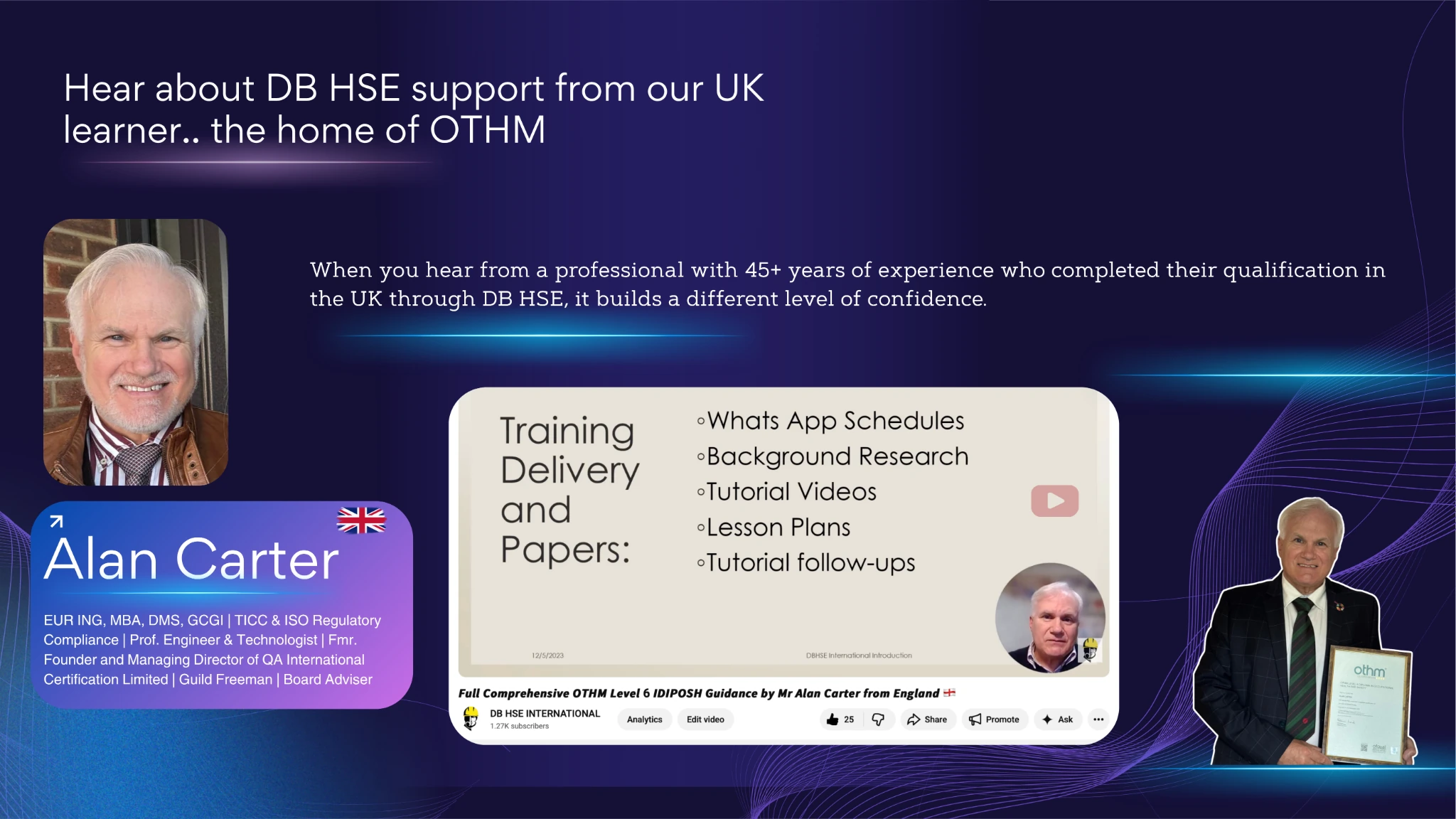 View full-size image
An OTHM Level 6 graduate’s perspective
Alan Carter completed the OTHM Level 6 Diploma in Occupational Health and Safety with DB HSE International. Hear his perspective as a UK learner and explore the guidance he shares about the learning journey and training support.
The video starts only when you choose Play.
Watch Alan’s video on YouTubeWhile you watch: As you watch, note two ideas that could help you organise your learning, use available support or prepare your own assignment evidence.
 View full-size image
Convocation and collaboration
Convocation brings learners and academic representatives together to recognise achievement. This shared celebration with Mega Jati Academy reflects the international connections surrounding DB HSE International’s learning community.
 View full-size image
Workshops, conversations and professional exchange
Learning also grows through conversation. From online sessions and workshops to meetings in person, these photographs show people exchanging experience, celebrating progress and building professional relationships around DB HSE International.